
CompanyWatch Case Review: Meta's November 6 Model Hand-Down — What Free Users Get, and What Stays Behind the Muse Wonder Paywall

Since November 6, Meta has been putting "specialized versions" of its existing models, trained with the flagship Muse Wonder, in front of ordinary Muse and Meta AI users, while Muse Wonder and the stronger Wonder Full remain inside paid subscriptions. The case matters because it turns a frontier model into a distribution asset: free users inherit two headline behaviours — Active Memory and Active Focus — while the expensive, complex work, and the inference bill that comes with it, stays behind the paywall.
Read this as a cost-and-pricing decision that happened to be announced as a model release. Below we reconstruct what Meta changed, why it retrained rather than downsized, what each tier still owns, and which five indicators tell you whether the bet is working.
What changed on November 6 — and what did not?
Conclusion first: capability moved down-market, capacity did not. Meta describes the new models as "specialized versions" of models already in its lineup, obtained by training with Muse Wonder. Their individual names have not been published, but they carry over the two abilities the Wonder series introduced first: "Active Memory" and "Active Focus".
Nothing moved at the top of the stack. Muse Wonder is still the flagship kept for paying subscribers who run more complex and higher-difficulty tasks, and it is sold to developers through Meta's model interface — Meta Model API — with charges based on input and output tokens. Wonder remains integrated into Meta Model API and the Muse Code coding assistant, and Wonder Full, the stronger model, is still limited to Muse Code's high-end paying users.
The sequence is short, which is precisely why the event is worth tracking:
- This September — Meta launches the personal assistant app Muse. Unlike several competing personal-agent products, which are gated to premium subscribers, Muse ships with a free usage tier that lowers the trial threshold.
- October 2026 — Muse Wonder and the more powerful Wonder Full are released; Wonder is wired into Meta Model API and Muse Code.
- November 6 — the Wonder-trained specialized versions begin rolling out to Muse and to Meta AI, the assistant distributed across WhatsApp, Instagram, Facebook and Messenger.
Why did Meta retrain instead of simply shrinking Muse Wonder?
Because the binding constraint is behaviour, not knowledge. Meta did not publish a trimmed-down Wonder; it retrained around consumer scenarios. The new models were made to learn what personal assistants actually do: when to execute a task on their own, when to check back with the user, and how to preserve context continuity when the user corrects something mid-task.
Meta has not detailed the training recipe, but it frames the objective as fitting personal-assistant needs rather than expanding general-knowledge coverage. The standard industry route is different: train a small model from a large one, then ship frontier capability to mass users at lower unit cost. Meta's version keeps that economics but changes the target variable — persistence and self-recovery instead of breadth.
Its own product logic says the same thing. A good personal agent should reserve a restaurant table, keep an inbox managed, remember what you mentioned a week ago, and carry on when a website breaks or a task is interrupted — without carrying everything a frontier model knows.
Analysts covering the category point at the same seam. In a September 2026 Stratechery essay, Ben Thompson argued that personal agents may build a stronger moat than chatbots, because once a user hands an assistant their accounts, information and routines, switching becomes far harder: memory and delegation, not raw model capability, create lock-in (as reported in summaries of the essay, mintresearch.org, September 21, 2026).
How much capability did the free tier actually gain?
Conclusion first: the published deltas are large, self-reported and behaviour-specific — directional evidence, not an audited benchmark.
Two internal test figures anchor the claim:
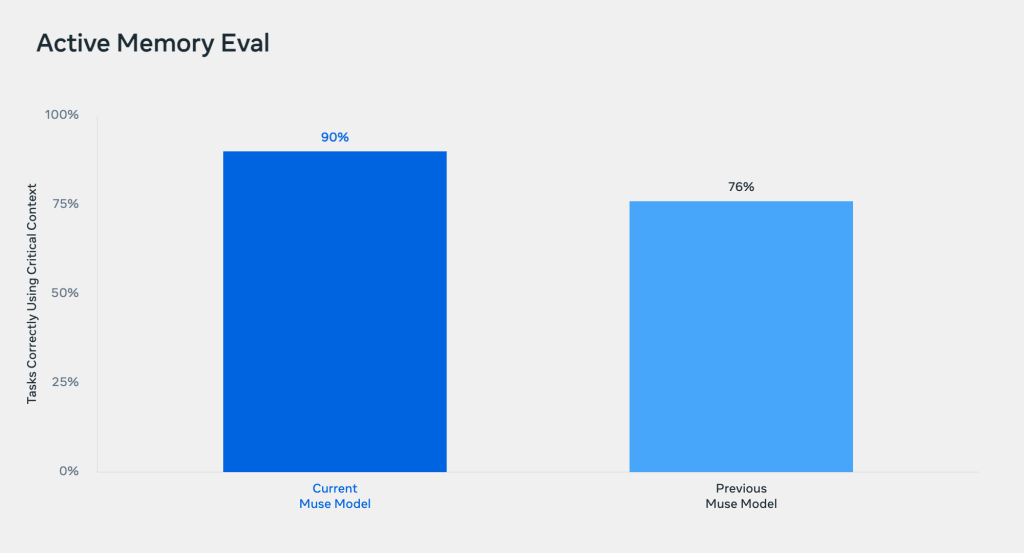
- Correct use of key context information during task execution: 90% for the new specialized models, versus 76% for the previous generation.
- Ability to complete routine tasks inside Muse after an unexpected problem appears: 67% better. Meta has not disclosed the specific benchmark behind that number, but says the models improved at autonomous decision-making, absorbing mid-task changes and pushing work forward.
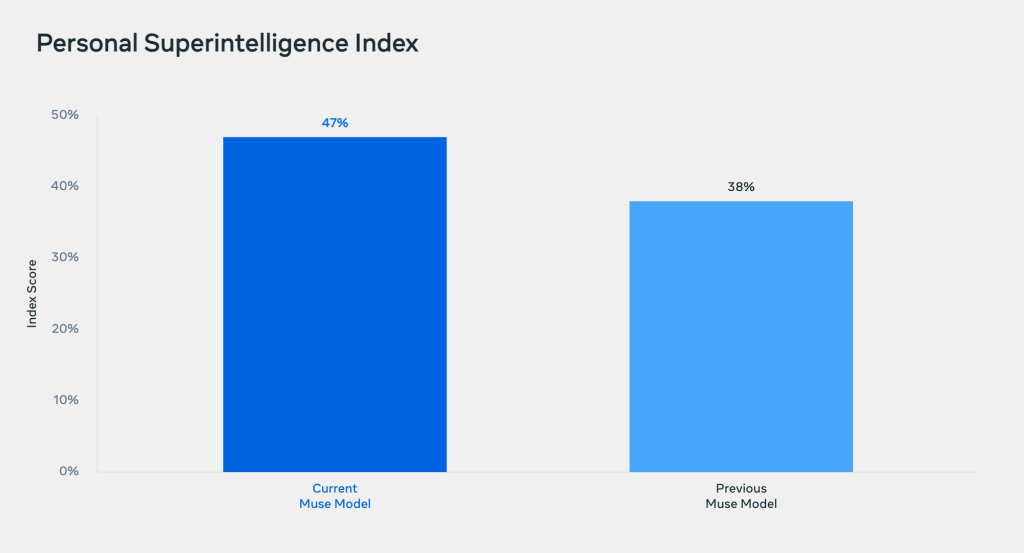
Meta's research blog adds a composite measure that the master announcement did not spell out: on its Personal Superintelligence Index — a gauge assembled from several personal and professional agent evaluations — the current Muse model scores 47%, up from 38% on the previous one (Meta AI Research, "Bringing Specialized Models to Muse and Meta AI", November 6).
How the two inherited capabilities differ is worth stating precisely, because they fail in different ways:
- Active Memory — long-horizon retention: separating transient content from what must be kept, and reasoning across time about which stored facts are still relevant and which are stale. Failure mode: confident use of outdated preferences.
- Active Focus — obstacle handling: trained on large numbers of real-world failure scenarios so that, when blocked, the model tries more solutions, recovers the flow or finds an alternative path rather than stopping. Failure mode: looping retries that burn tokens.
What is still behind the paywall — and what does access cost?
Conclusion first: Meta's free layer is now an everyday agent; the frontier remains a tool for heavy, complex work.
| Model or surface | Where it stands after the November 6 update |
|---|---|
| Muse Wonder | Flagship, reserved for paid subscribers who run more complex and higher-difficulty tasks; served to developers through Meta's model interface and billed per input and output token |
| Wonder | Integrated into Meta Model API and the Muse Code coding assistant |
| Wonder Full | Stronger still, and currently open only to Muse Code's high-end paying users |
| New specialized models | For Muse and Meta AI users; trained with Muse Wonder to meet the specific demands of a personal assistant, names not disclosed |
| Meta AI | Distribution layer, already embedded across WhatsApp, Instagram, Facebook and Messenger |
Pricing, from Meta's own subscription documentation, shows how thin the capability gap is between the two paid consumer plans: a free tier, Power at $20 a month with about 500 million Muse tokens per week, and Maximum at $100 a month with about 3 billion tokens per week (Meta Help Center, "About Muse subscriptions"). The paid consumer plans therefore sell headroom, not a different model — the pattern our enterprise comparison of Perplexity's $200-per-month Teammates also documents: agent products compete on quota and persistence, then on model access.
Why this is a cost decision before it is a capability decision
Conclusion first: serving hundreds of millions of people directly from a frontier model does not compute; serving them from a Wonder-trained specialist does.
Meta's own financial disclosures set the pressure. At its third-quarter update on October 21, 2026, the company narrowed 2026 capital expenditure guidance to $135–145 billion, having started the year with a $115–135 billion forecast and moved through $130–145 billion mid-year, with AI infrastructure driving the revisions (Meta Investor Relations press release, October 21, 2026). Sell-side modelling of the consumer agent business is blunt about why the free tier cannot simply be the flagship: Morgan Stanley's internet team, led by Brian Nowak, estimated direct serving costs of roughly $3 to $130 per user per month depending on token intensity, with a base case near $37 when a user consumes about a quarter of the weekly quota — a range that makes unmetered frontier access commercially impossible.
The revenue side is equally hard to size. Oppenheimer's Jason Helfstein calculated that Meta would need around 115 million paying Muse subscribers at $20 a month to generate roughly $28 billion a year, a threshold he considered unlikely in the near term (24/7 Wall St. via Yahoo Finance, September 20, 2026). Read together, those numbers are the practical lesson of the November 6 rollout: free capability is a customer-acquisition cost that must eventually be recovered through subscriptions, quota upgrades, or the transactions an agent completes. It extends the longer arc we follow in our review of Meta's AI productivity bet against a shrinking workforce.
Four misconceptions CompanyWatch readers should drop
- "Free users now have Muse Wonder." They do not. What ships to Muse and Meta AI are specialized versions trained with Muse Wonder; the flagship stays with paid subscriptions for complex, higher-difficulty tasks.
- "These are renamed small Wonder models." Meta's own description is scenario-specific retraining aimed at assistant behaviour — timing of autonomous action, confirmations, and recovery after corrections — not a size cut, and no training method has been disclosed.
- "Wonder Full is just a bigger quota." It is positioned as stronger capability, currently reserved for Muse Code's high-end paying users rather than resold as extra tokens.
- "90% means the agent is dependable." That figure measures correct use of key context during a task in internal testing — not a public benchmark of completed real-world jobs, and not a safety or accuracy certification.
What to watch next: a five-point tracker
- Names and public benchmarks. Whether Meta publishes the specialized models' identities and third-party-comparable scores; until then, treat 90%, 76%, 67% and the 47%/38% index move as vendor-reported.
- Wonder Full's surface area. The October 2026 announcement confirmed Muse Code subscriber access only. If Wonder Full ever appears on the Meta Model API pricing page, the premium-tier thesis weakens and enterprise competitors feel it first.
- Quota mechanics on Power and Maximum. Token ceilings — the 500 million and 3 billion weekly figures — are the fastest visible sign of inference-cost stress, and usually tighten before prices rise.
- Disclosure of agent revenue. Watch the next quarterly report for whether Meta separates subscription or transaction revenue from Muse and Meta AI; without it, the $28 billion scenario stays unverifiable.
- Delegation depth and permissions. Memory that persists across weeks is also risk that persists: which controls let users inspect, expire or delete what Active Memory has stored, especially inside WhatsApp, Instagram, Facebook and Messenger.
FAQ: Meta's specialized models, answered quickly
Are Muse Wonder and Wonder Full now free?
No. Muse Wonder remains for paying subscribers handling more complex and higher-difficulty tasks, and Wonder Full remains exclusive to Muse Code's high-end paying users. What reached free users on November 6 are specialized versions trained with Muse Wonder.
What are Active Memory and Active Focus in plain terms?
Active Memory decides what to keep long-term and what has gone stale, then reasons across time; Active Focus keeps a task moving when it hits an obstacle by trying more solutions or finding another path. Both were introduced in the Wonder series and are the two abilities carried into the new models.
Do I need a paid Muse plan to use the new models?
The specialized models roll out to Muse and Meta AI users, and Muse keeps a free usage tier. Paid plans — Power at $20 a month and Maximum at $100 a month — mainly buy larger weekly token allowances, not a different base model.
Why should an investor care about a model rollout?
Because it reveals the cost curve. Meta is spending $135–145 billion in 2026 on capital expenditure, much of it AI infrastructure, and needs the consumer agent base to be served by cheaper specialized models while heavy workloads are billed per token through Meta Model API or upsold to Muse Code.
Is this the same as model distillation?
Related but not identical. Distillation transfers capability from a big model to a small one; Meta says these models were trained with Muse Wonder for personal-assistant behaviour, and has not disclosed the method or the resulting architecture sizes.
Sources consulted
- Meta AI Research — "Bringing Specialized Models to Muse and Meta AI" (November 6, 2026): https://research.meta.ai/blog/specialized-models-for-muse-and-metaai
- About Meta — "Introducing Muse Wonder and Muse Wonder Full" (October 2026): https://about.fb.com/news/2026/10/introducing-muse-wonder-models/
- Meta Help Center — "About Muse subscriptions" (free tier; Power $20/month; Maximum $100/month): https://www.meta.com/help/subscriptions/1021145227643680/
- Meta Investor Relations — "Meta Reports Third Quarter 2026 Results" (October 21, 2026): https://investor.atmeta.com/investor-news/press-release-details/2026/Meta-Reports-Third-Quarter-2026-Results/default.aspx
- 24/7 Wall St. via Yahoo Finance — Oppenheimer estimate on Muse paying-subscriber thresholds (September 20, 2026): https://finance.yahoo.com/markets/stocks/articles/analyst-meta-needs-just-115-160303165.html