
GlobalBizSight CompanyWatch: A Playbook for Tracking Nvidia Control and Succession Risk After the November 8 Disclosure
GlobalBizSight's CompanyWatch answer: the November 8 Nvidia disclosure turns a personal-relationship controversy into a governance stress test because Jensen Huang controls 3.58% of shares through family trusts, has no announced successor, and sits as the only executive inside an 11-member board. The practical question is not whether he remains CEO today, but which legal, board, investor and supply-chain signals could change Nvidia's control and leadership path next.
Nvidia says Huang, who has served as CEO for more than 30 years, will continue to lead the company without interruption. What changed on November 8, local time, was the governance lens: a board review of reports that he may have been targeted by a foreign intelligence operation, alongside a personal admission that moves trust from employee confidence into legal and voting structures.
What Changed on November 8, and What It Signals for Nvidia Governance?
The first task is to separate confirmed statements from unresolved allegations. Huang acknowledged in an employee note that he had been 'unfaithful' to his wife, Lori Huang, and said he would cooperate with the investigation, according to Business Insider. The board opened an independent review, with a committee of independent directors and outside counsel, as described by The Wall Street Journal. Neither fact by itself removes a CEO; together they create a monitoring agenda for shareholders, board-watchers and partners.
For readers tracking Nvidia outside the headlines, the next event is usually a filing, not a quote. The same ownership package also sits behind investor debates over Nvidia buybacks and data-center policy risk, which means governance uncertainty can quickly become a capital-allocation question.
Why Does a 3.58% Founder Stake Matter If Nvidia Has No AB Shares?
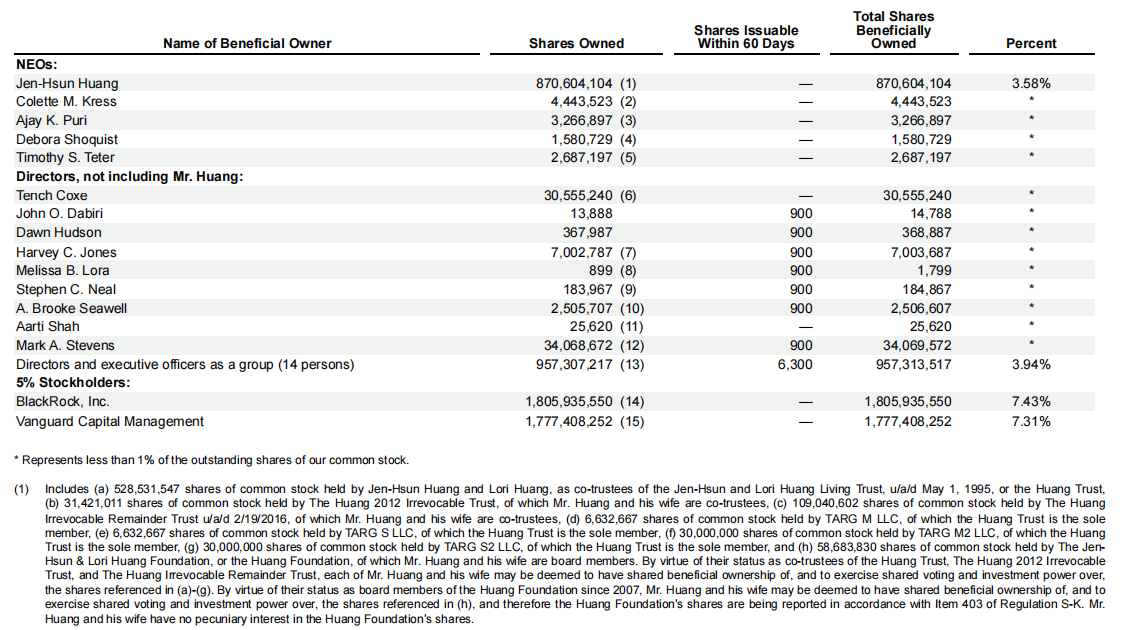
Short answer: because the 3.58% stake is not just a personal holding. Nvidia has no AB dual-class structure. In May of this year, Nvidia submitted a formal filing to the U.S. Securities and Exchange Commission, or SEC. As of March 23, 2026, Huang held 870.6 million shares of common stock, equal to 3.58% of shares.
The stake is distributed across family trusts and holding entities that also benefit his wife, Lori Huang. Among the shares associated with Huang's control, the Jensen Huang and Lori Huang inter vivos trust - Huang Trust - held 528.5 million common shares, or 60.7% of those controlled shares, with Huang and his wife as co-trustees.
Other vehicles - Huang Irrevocable Remainder Trust, Huang 2012 Irrevocable Trust, TARG M LLC, TARG S LLC, TARG M2 LLC and TARG S2 LLC - held 213.7 million common shares. These entities either name Huang and his wife as co-trustees or have Huang Trust as sole member. The Jensen Huang and Lori Huang Foundation held 58.6838 million shares, with Huang and his wife on the foundation board.
Through those arrangements, shares carrying joint beneficial ownership and joint voting and investment rights total 801 million shares, about 92% of shares controlled by Huang. The gap between 870.6 million shares and 801 million shares implies no more than 69.66 million shares held directly by Huang at that disclosure date.
Because Huang married Lori Huang before Nvidia's founding in 1993, a divorce or estate dispute could alter the voting bloc if trust terms allow it. However, there is no public evidence that Lori Huang has separately influenced Nvidia director elections or disagreed with Huang in major shareholder decisions. There is also no public evidence that this episode has changed the marriage, family trusts or share-voting arrangements.
How Does Nvidia's Board and Management Structure Absorb Founder Risk?
Conclusion: the governance system is strong on paper, but operationally narrow. Nvidia's ownership is dispersed beyond the founder. Institutional holders above 5% are BlackRock, Inc., and Vanguard Capital Management. Their stakes are 7.43% and 7.31%, respectively. The same SEC filing shows four of the five named executives hold less than 1% of outstanding common stock.
Management design intensifies the key-person question. Nvidia has no chief operating officer. Its workforce is above 40,000, but reporting is flat, with dozens of direct business heads reporting to Huang. The board has no chairman; aside from Huang, directors are independent. One independent director serves as lead independent director. Huang is the only management member inside a board that now has 11 directors. At the May disclosure there were 10 directors; all were re-elected at the June shareholder meeting. The nine directors other than Huang each own less than 1%, and the largest independent holder is Mark A.Stevens, with 34.0696 million shares.
Huang, 63, has not publicly laid out a successor plan. In March this year, in a podcast discussion, he said he had publicly expressed distrust of succession plans and argued that frequent teaching of knowledge, information, insight, skill and experience was a better use of time than anxiety about eventual handover; he framed his aim as continuing to work in the role for life.
For governance professionals, that stance resembles a classic founder-CEO key-person exposure: the operating model is aligned to one leader's judgment. Risk-management guidance from Wolters Kluwer notes that many organizations now formally treat 'key person' risk within enterprise risk management frameworks, with succession planning identified as a mitigating control. The practical implication is not that a successor must be announced, but that continuity must be tested.
What Precedents Show About External Pressure on Nvidia?
Nvidia has faced outside pressure before. Activist hedge fund Starboard Value, known for seeking board seats and pushing operational changes, sent a letter to Nvidia's board in 2013 during a period when the company was involved in multiple businesses. The letter questioned whether Huang was steering the company toward ruin. Huang listened to Starboard's chief investment officer, exited the modem market, and still persuaded multiple institutional investors to support investment in CUDA. The outcome was that Huang did not hand business strategy to outside investors.
The precedent matters because today's share distribution is more concentrated in index and activist funds than in a single founder-controlled voting bloc. If Huang's equity or role changed without a prepared successor, market observers would test whether institutional shareholders can shape leadership, whether an activist could gain board influence, and whether Nvidia's position as the largest global AI chip company and AI infrastructure advocate could be used as a governance shield. The company remains central to U.S. technology ecosystems, where no rival has matched its current breadth.
A Step-by-Step Checklist for Tracking Control and Succession Signals
- Start with filings, not speculation. Check the SEC filing trail for beneficial ownership, trust entities and executive voting rights, beginning with Nvidia's SEC filing record.
- Map the voting bloc. Track whether Huang Trust, foundation holdings and TARG entities remain aligned, and whether any public filing shows separate voting interests.
- Watch board mechanics. Monitor the independent committee's scope, external counsel findings, lead director actions and whether any director changes their committee role.
- Test the executive bench. Look for formal delegation, COO creation, clearer divisional ownership or repeated public appearances by business heads reporting to Huang.
- Track investor pressure points. Follow activist letters, proxy proposals, director nominations and index-fund engagement disclosures.
- Read supply-chain and customer continuity. A leadership transition would be judged first through CUDA ecosystem support, AI infrastructure commitments and large-customer relationship continuity.
Common Misreads to Avoid
| Misread | Why it is incomplete | Better signal |
|---|---|---|
| 3.58% means Huang has little influence | Control depends on dispersed institutions and family trust voting power, not one direct holding. | Changes in trust ownership, joint voting arrangements or named executive holdings. |
| A board investigation means removal is near | The board can investigate while confirming leadership; the review addresses reports and governance facts. | Whether the committee reports evidence of harm, changes leadership status or expands mandate. |
| Flat management means succession is ready | Dozens of direct reports and no COO create coordination load for any successor. | Delegation announcements, formal executive committee or interim governance mechanisms. |
| Personal apology settles governance risk | Trust and family-law consequences may remain unresolved. | Filings showing changed beneficial ownership, trustee substitutions or separate voting control. |
Practical Actions by Reader Type
- Investors: Do not trade on the headline alone. Build a trigger list: SEC ownership updates, board committee results, executive retention disclosures and proxy-season pressure from large holders.
- Industry analysts: Separate governance risk from operating momentum. Compare Nvidia with AMD and Intel not only on product cycles, but on whether leadership continuity is disclosed as a formal risk factor.
- Enterprise buyers: Ask vendors for contract-level continuity terms: named executive sponsor, escalation path, certification sign-off and product roadmap approval authority.
- Corporate strategists: Model three scenarios: status quo leadership, board-assisted transition, and contested ownership. For each, map consequences for CUDA ecosystem, AI infrastructure commitments and partner confidence.
Frequently Asked Questions
Does Jensen Huang still control Nvidia?
He remains CEO and the central founder figure, but control is a governance question rather than a single number. His 870.6 million common shares, or 3.58% of shares, are spread across trusts and entities with Lori Huang as a co-beneficiary, co-trustee or board member in several cases.
What would materially change Nvidia's control risk?
The largest changes would be a public filing showing separate voting control of Huang Trust shares, a change in trustee or foundation governance, or board action that removes or suspends Huang's executive powers. As of the disclosed filings, there was no public evidence of those changes.
Is there a named successor?
Nvidia has not publicly disclosed a named successor, and Huang's own remarks in March this year expressed distrust of succession planning. That makes bench-building and delegation more important than a single announcement.
Why does Starboard Value's 2013 letter still matter?
It shows that external pressure can be absorbed when a founder-CEO retains strategic conviction and investor backing. The 2013 case also shows that CUDA investment was defended against short-term activist pressure, a useful comparison for how future leadership might protect long-cycle platform spending.