
Sony China's Camera-Free Wi-Fi Fall Detection: A CompanyWatch Q&A on the Privacy Bet, Shanghai Pilots and Buy-Side Signals
Short answer: Sony (China) Co., Ltd. gave a privacy-first fall monitor a global debut at the 9th China International Import Expo (CIIE), held in Shanghai from November 5 to 10, 2026. The technology is credible and is already running in live Shanghai pilots, but it is not yet a disclosed business. The decision-grade questions are detection accuracy across different bodies and rooms, coverage when more than one person is present, and whether pilot sites convert into priced deployments.
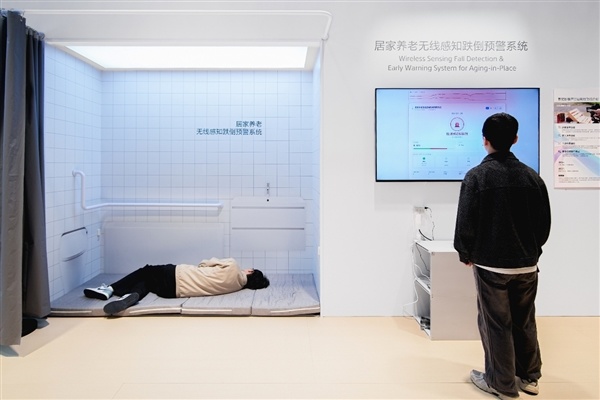
What did Sony China actually put on the floor?
Conclusion first: the launch is a room-level safety monitor that reads the radio environment instead of reading the person, and it is pitched at care settings rather than at gadget buyers.
- Working principle: human movement changes how Wi-Fi signals propagate. The system collects channel state information (CSI), then combines it with human-motion features and deep-learning algorithms to identify a fall, raising an on-site audio-visual alert or pushing an alarm through an app or mini program.
- Hardware set: only a Wi-Fi signal transmitter, a receiver and a data processor. Because there is no camera and no image capture, the privacy risk tied to imagery is removed at the design stage rather than managed by policy promises.
- Detection envelope: common fall types including slow falls and slips, specified for single-person detection.
- Deployment friction: once powered on the unit enters monitoring state automatically, with no complex commissioning — the detail that matters most to home installers and under-staffed care homes.
- Target settings: bedrooms and bathrooms in private homes, plus care facilities and community elderly services, extending to public health service centres, nursing homes, rehabilitation institutions and medical institutions.
- Origin: developed locally by Sony China Research Lab, with the University of Science and Technology Beijing involved during the R&D process.
Why trade the camera for a Wi-Fi signal?
Conclusion: privacy, not accuracy, is Sony's headline argument — and it is the correct argument, because the bathroom is where falls are most lethal and where cameras are least welcome.
The trade-off splits three ways. The older person wears nothing and is not interrupted in daily life. The family or care institution never faces the discomfort of picture capture, which is why the bedroom and the bathroom are the rooms the system targets. The caregiver receives a fall alert without adding another video wall to watch.
On the expo floor, the vendor's own evidence was a live test rather than a slide deck. According to CIIE coverage reprinted by the Beijing municipal government portal, a researcher lay down on the floor of Sony's mock bathroom to simulate an elderly fall, and within three seconds the screen showed that someone had fallen. Liu Shijia, Senior Manager of Corporate Information and Media at Sony, was quoted in the same report saying that many older people are unwilling to have a household camera filming them all day. She explained that the product reads how walking and breathing alter the reflection and propagation of Wi-Fi signals, then infers activity and posture from those signal changes, so it can confirm that a user has fallen rather than simply sat down to rest.
| Approach | Acceptable in a bathroom? | What the user must do | Weak point to verify |
|---|---|---|---|
| Wi-Fi sensing (CSI plus deep learning), Sony China's approach | Yes — no image is captured, so the “seeing no image” logic holds | Nothing: no wearable, no charging, no app to carry | Specified for single-person detection; model transfer across different bodies is a documented research challenge |
| AI camera or vision-based monitoring | Rarely — consent objections concentrate here | Nothing, but must accept being filmed | Richest signal, weakest privacy position in private rooms |
| mmWave radar | Yes — image-free by design | Nothing | A 2026 clinical engineering study reported 97.9% accuracy across 10 multi-person scenarios, plus per-room device cost |
| Wearable pendant or smartwatch | Works anywhere the person wears it | Must be worn and charged daily | Non-adoption; the US CDC notes more than one in four adults 65 and older falls each year, and fewer than half tell their doctor |
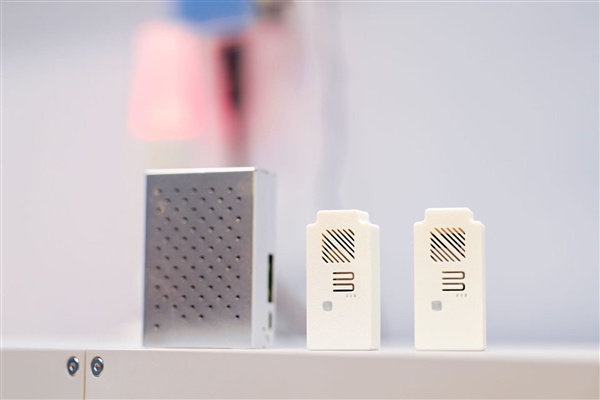
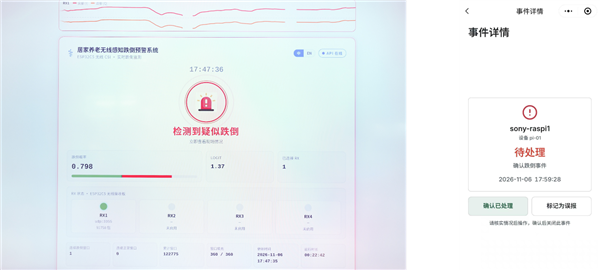
What the booth showed about install effort
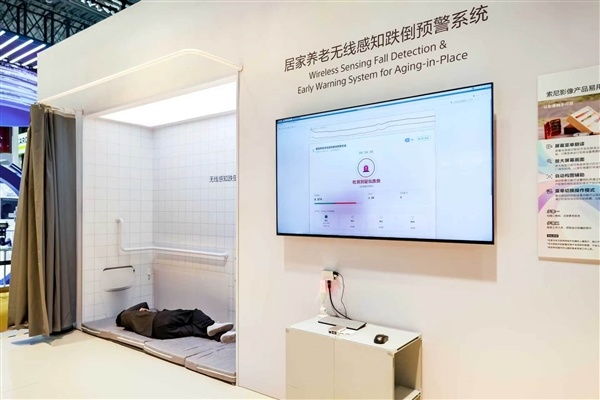
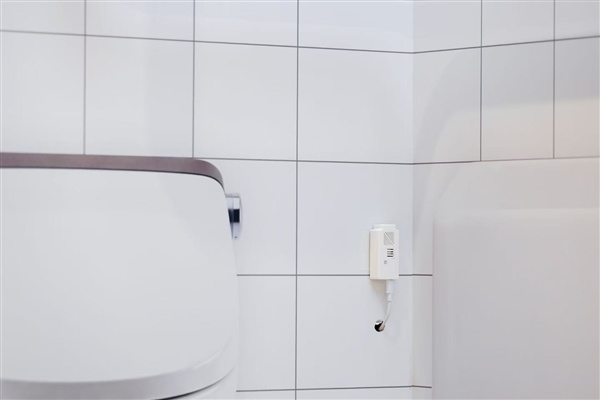
Sony's stand built a mock-up of an ordinary bathroom. During the demonstration, a staff member simulated a fall, the alarm fired, and the alert was synchronised in real time to a wall-mounted TV screen. Visitors could then walk into the space under staff guidance and experience a simulated fall themselves, seeing directly how the system raises an alarm on the premise of seeing no image at all — no picture, only a change in the radio environment.
The commissioning story is the quiet commercial point: the system enters monitoring state automatically once powered on, so a care home can trial it room by room without an IT rollout, and a family can install it without a site survey. That is the difference between a product that can be sold through retail channels and a project that has to be engineered per customer.
Is there a paying market behind the exhibit?
Conclusion: demand-side pressure is real and policy-backed, which is why a foreign electronics group is putting a non-revenue prototype on a state fair stage.
- Scale: China's population aged 60 and above reached 323.38 million by the end of 2025, about 23% of the total, according to National Bureau of Statistics figures carried by the Global Times.
- Labour gap: the Ministry of Civil Affairs counted a shortage of roughly 5.5 million care workers in 2024, the China Daily reported — a structural reason to automate detection rather than hire more eyes.
- Severity: the World Health Organization estimated about 842,000 deaths from falls worldwide in 2023, making falls the second-leading cause of unintentional injury death, with roughly 71% of those deaths among adults aged 60 and older.
- Policy timing: on November 4, 2026 — the day before CIIE opened — six central departments including the Ministry of Civil Affairs, the National Development and Reform Commission and the Ministry of Industry and Information Technology issued measures to cultivate elderly-product consumption scenes, explicitly pushing smart security products into retrofitted homes and letting community care facilities run trial, display, rental and sale outlets (full text published by China News Service). Earlier, in January 2026, Xinhua reported that guidelines from eight central departments encouraged advanced technology use in elder care.
- Fair context: the organisers counted more than 480 representative world premieres, Asian debuts and China debuts at this edition, a record for the event, per the pre-fair briefing carried by Xinhua.
Sony's own framing is corporate rather than charitable. This was Sony China's fifth showing in the Technology Equipment exhibition area, staged in a year that marks the Sony Group's 80th anniversary and the 30th anniversary of Sony China, with 7 global premieres or first shows and 5 China premieres or first exhibits, six of them locally developed, according to the company's own news release on the fair. Takeshi Yoshida, President of Sony (China) Co., Ltd., has described three decades of moving from local manufacturing towards research, design and content creation in China — the same logic that produced a Wi-Fi sensing product inside Sony's China R&D network.
The commercial caution belongs in the same paragraph as the demand data: nothing in the expo materials disclosed a price, a SKU, a service contract, a named customer count or a segment line where the revenue would land. An expo debut only becomes a business case when the hardware is working unattended at scale, the transition documented for humanoids moving from demos to warehouses. On that standard, Sony's system is at the pilot stage, not the product-launch stage.
Which failure modes belong on a pilot checklist?
Conclusion: assume the demo ran in the best conditions in the room, and test the issues that do not appear in a three-second clip.
- Two people in one room. The disclosed specification is single-person detection, so households where a spouse and the monitored senior are both present are the hardest case.
- Cross-body and cross-room transfer. Peer-reviewed work on CSI fall detection built its dataset from 1,800 fall samples and 2,400 daily-activity samples contributed by 20 volunteers precisely because performance across individuals is the open problem; ask the vendor how many real elderly users, not volunteers, sit behind the accuracy figure.
- Look-alike events. Sitting down quickly, squatting, dropping laundry, a pet jumping off a bed or a curtain moving in a draught are the false-positive classes that drive alarm fatigue.
- Radio environment churn. A router swap, a new mesh node, a flatmate or changed furniture rewrites the signal baseline; find out whether recalibration is automatic or on-site.
- Coverage arithmetic. One kit is a room-level device, so a flat with three rooms needs a deployment map and a clear escalation rule when alerts come from several rooms at once.
- Integration and duty of care. Determine whether alerts reach an existing nurse-call platform or stop at an app or mini program, and who answers a 3 a.m. alarm when no one is awake to hear the audio-visual signal.
- Data governance. Absence of images is not absence of data: presence, activity and daily-rhythm inference still fall under personal-information rules, so clarify edge versus cloud processing, retention and access rights.
- Validation transparency. Ask for pilot start date, number of monitored rooms, events logged, false-positive and missed-event rates — the pilot is in live running now, so these numbers should exist internally.
Common misconceptions to retire
- “No camera, no data risk.” The system removes imagery, not behavioural data. Privacy here is a design improvement, not an exemption.
- “A world premiere is a market launch.” Debut status signals that the company is ready to be judged publicly; it does not signal price, availability or service coverage.
- “Fall detection equals fall prevention.” The device shortens response time after an event; balance exercise and home-hazard reduction remain the interventions that reduce the odds of falling in the first place, as the WHO frames its Step Safely approach.
- “One device, one protected parent.” Room-level, single-person sensing means the coverage unit is the room and the household, not the person.
- “A Japanese brand means a proven care business.” Sony's track record in this category is a locally developed system now piloting in Shanghai — a credibility asset, not yet a care-services franchise.
Q&A: the questions that decide the call
Does a household have to replace its Wi-Fi?
The disclosed configuration is a self-contained set — a Wi-Fi signal transmitter, a receiver and a data processor — that starts monitoring automatically once powered on. Whether the kit reuses an existing home router is not addressed in the expo material, so treat it as a test question, not an assumption.
Is it a medical device?
Nothing in the expo presentation positions it as one. It is presented as a care-safety monitor for homes, community services, institutions and medical settings. Classification and procurement eligibility should be confirmed against current Chinese elderly-product standards before any institutional purchase order is signed.
Can it tell a fall from sitting down?
Sony's public explanation is that the system infers activity and posture from signal changes caused by movement and breathing, and therefore distinguishes a fall from someone sitting down to rest, with the demo triggering within three seconds. That is a vendor description of a designed behaviour; buyers should require event logs from their own rooms.
Should a family buy it today?
No. It is a globally debuted system that is piloting in Shanghai while stability and detection accuracy are being validated through real operation. The sensible household move is to watch for a priced retail or service package and for published accuracy figures.
What is Sony actually competing against?
Three incumbents: wearables, where non-adoption is the weakness; camera-based AI monitoring, where consent is the weakness; and mmWave radar, which is also image-free and reports strong multi-person accuracy. Sony's wedge is the combination of no wearable, no image and a household Wi-Fi deployment that a care operator can commission room by room.
What to track next, and what to do now
For investors and industry analysts, treat the pilot as a disclosure trigger. The watch list: whether Sony names pilot sites and monitored-room counts; whether a price or a bundle with a care-service partner appears; whether the product is folded into a stated business unit rather than left as a fair exhibit; and whether the follow-on R&D with the University of Science and Technology Beijing is published with measurable results. This is exactly the kind of slow-burning single-company event that a CompanyWatch tracking playbook is designed for: set indicators before the news flow, then judge each update against them.
For care operators and business-development teams, the low-cost move is to run a bounded trial. Define the room, the number of residents, the alert-escalation path and the false-alarm tolerance in advance; ask for the vendor's single-person limitation in writing; and compare the total cost against a wearable programme plus one extra staffing shift, because the economics of this category are won or lost on labour, not on hardware.
For market researchers, log the policy calendar rather than the product. The measures issued on November 4, 2026 explicitly open community facilities to trial, rental and sale outlets for elderly products, which converts a trade-fair exhibit into a procurement channel. Tracking which provinces publish implementation details will show the demand curve long before corporate filings do.
Sources
- Beijing municipal government portal, CIIE coverage including the three-second demo and the statement by Liu Shijia, November 7, 2026: https://www.beijing.gov.cn/fuwu/lqfw/gggs/202611/t20261107_4936626.html
- Sony (China) official news release on its 12 premieres at the fair, November 5, 2026: https://www.sony.com.cn/content/sonyportal/zh-cn/cms/newscenter/corporate/2026/20261105-3.html
- China News Service, full text of the six-department measures on elderly-product consumption scenes, dated November 4, 2026: https://www.chinanews.com.cn/cj/2026/11-06/10727258.shtml
- Xinhua English, eight-department guidelines on technology-enabled elderly care, January 13, 2026: https://english.news.cn/20260113/e69a9ed62b8946848e5f59cae7d3a540/c.html
- Xinhua preview of the 9th CIIE, more than 480 representative premieres, October 16, 2026: https://www.news.cn/world/20261016/dad71a54e7e74a84a1b318e29abf1ed0/c.html
- World Health Organization falls fact sheet, 2023 estimates: https://www.who.int/news-room/fact-sheets/detail/falls
- Global Times on the National Bureau of Statistics count of China's 60-and-above population, July 2026: https://www.globaltimes.cn/page/202607/1367295.shtml
- China Daily on the Ministry of Civil Affairs care-worker shortage figure, July 30, 2025: https://www.chinadaily.com.cn/a/202507/30/WS6889bf73a310c26fd717c8b7.html
- US CDC older adult falls data: https://www.cdc.gov/falls/data-research/facts-stats/index.html
- Peer-reviewed CSI fall-detection study, 1,800 fall and 2,400 daily-activity samples from 20 volunteers: https://pmc.ncbi.nlm.nih.gov/articles/PMC11151769/
- 2026 study on mmWave multi-person fall detection accuracy: https://pmc.ncbi.nlm.nih.gov/articles/PMC12988233/