
CompanyWatch Practical Guide: How Tesla's Cybertruck Wind-Down Signals a Cybercab Line-Swap, Backlog Reset and Capital Trade-Off
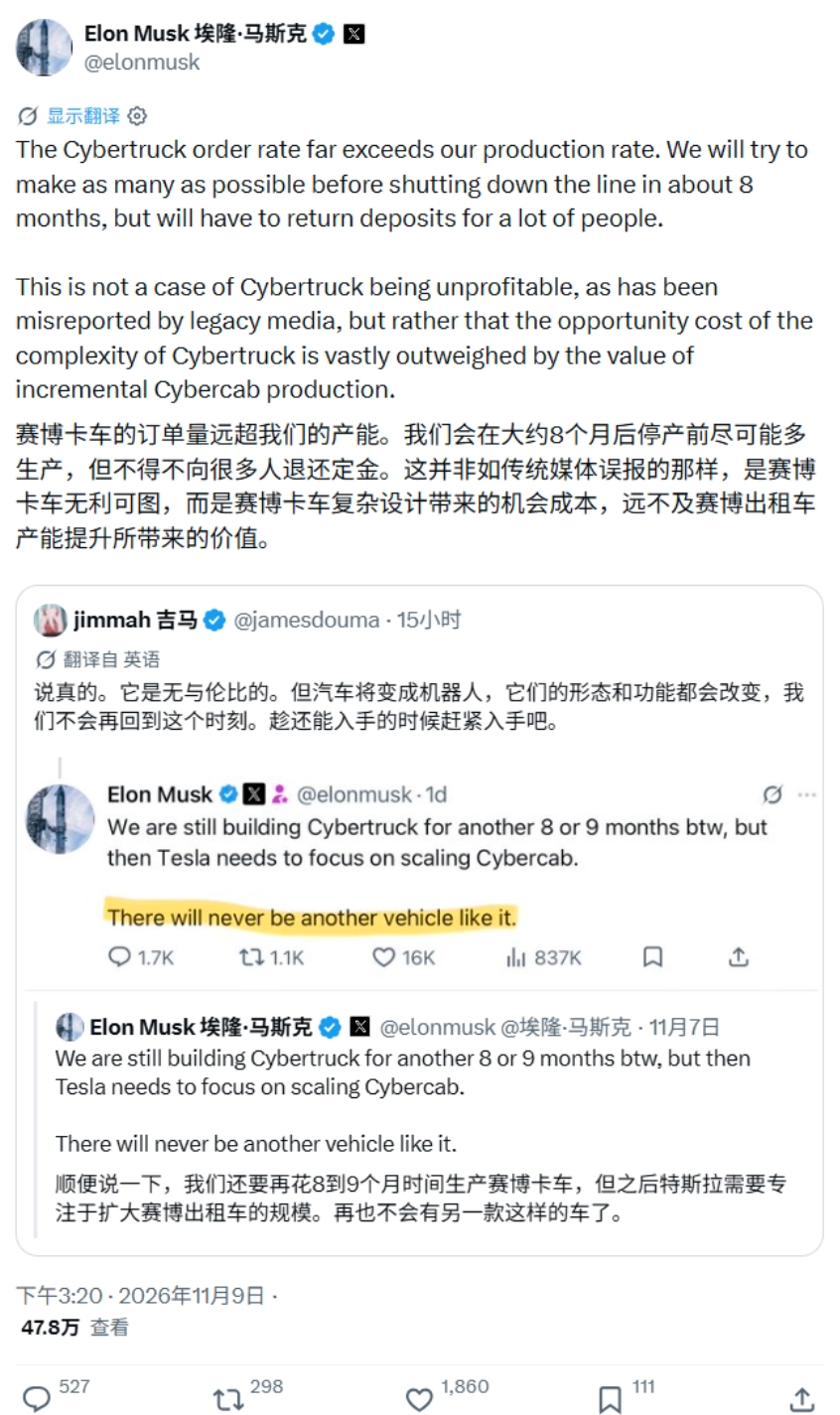
On November 9, Musk said on X platform that Cybertruck order growth is outrunning capacity, yet Tesla will wind down production at Texas Gigafactory in about 8 months, around mid-2027, to free capacity for Cybercab. For CompanyWatch readers, the practical takeaway is a line-swap, refund-clearing and robotaxi-ramp signal — not proof that Cybertruck is not profitable.
What exactly changed in Tesla's Cybertruck plan?
The short answer: Tesla is stopping one low-volume, high-complexity pickup program to expand a purpose-built robotaxi program. Musk said the real reason is not the media claim that Cybertruck is not profitable; it is that Cybertruck's manufacturing complexity creates opportunity costs larger than the value from adding Cybertruck volume, when compared with expanding Cybercab.
The timing is narrow: production continues for roughly eight months, then winds down at the Texas facility. The practical consequence is not a simple 'cancellation' headline. It is a capacity reallocation, with Cybercab, Tesla's L4-level Robotaxi design without a steering wheel or pedals, becoming the priority asset.
Why does the Cybertruck backlog matter if Tesla is winding down the line?
Because backlog pressure makes the transition operational, not only strategic. Musk said orders far exceed what Tesla can deliver before the line is dismantled, and many deposits will need to be returned. Tesla has been adding shifts to clear as many orders as possible, according to Reuters coverage of the plan.
That creates a three-part checklist for analysts: (1) order-book cleanup, (2) deposit-refund execution, and (3) production-line shutdown. A company can be commercially viable on paper and still be strategically uneconomic if its scarce capital is better used elsewhere.

How does Cybertruck's sales record frame the decision?
Cybertruck has a long history of delays and limited visibility. It was announced in November 2019 with reservations opening, and first deliveries began in November 2023. Tesla had once cited more than 1 million reservation orders.
Tesla does not disclose Cybertruck sales separately. In Q2 2026, Tesla's total deliveries were 480,126, while the 'Other Models' group — Cybertruck, Semi and the last batch of Model S/X — accounted for 12,364 deliveries, per Tesla investor-relations reporting. During the first three quarters of this year, Cybertruck sales fell 28% year on year to about 11,600 units.
What technical value survives after the pickup line closes?
Lead engineer Wes Morrill described Cybertruck as a technology development platform. The 48V low-voltage architecture, steer-by-wire system and Etherloop wiring architecture already carry forward into Cybercab. For a CompanyWatch review, that is the most important nuance: Tesla can end a vehicle line while preserving the engineering assets that reduce risk for the next product.
Cybercab is not merely a smaller car. It is Tesla's main Robotaxi vehicle concept, built around an L4-level design with no steering wheel and no pedals. The company launched production in Texas in 2026 and started road testing in Austin.
Is this Tesla's first production line swap for a strategic pivot?
No. In January 2026, Tesla announced that Model S and Model X production would end, with related lines converted to support Optimus humanoid robot manufacturing. The pattern is consistent: legacy, low-volume, premium hardware lines are repurposed for higher-priority platforms. CNBC reported Musk's confirmation of the S/X line change, giving investors a second reference point for how Tesla treats capacity.
For readers tracking Tesla's product mix, see our CompanyWatch comparison of Cybertruck against EV pickup rivals and the latest Cyberbeast price position at USD 102,490.
Practical tracking guide: five checks to run after the Cybertruck announcement
- Confirm the line, not only the model. Watch Texas Gigafactory space, tooling removal, supplier notifications and staffing changes for Cybercab ramp.
- Track the backlog waterfall. Count how many orders are fulfilled before the wind-down and how many are refunded, including region-specific deposits.
- Separate product failure from capital allocation. A program can be technically valuable while being less valuable than the next product.
- Follow the technology transfer. Monitor whether 48V, steer-by-wire and Etherloop adoption in Cybercab improves cost, safety validation and serviceability.
- Read the robotaxi constraints. L4-level testing, Austin road tests and regulatory boundaries can delay value capture even if capacity is ready.
Common misconceptions and risk flags for CompanyWatch readers
- Misconception: The wind-down means Cybertruck was always unprofitable. The stated cause is opportunity cost, not a simple loss-making verdict.
- Misconception: Refunds equal lost demand. They may simply reveal that production capacity and reservation expectations were out of step.
- Risk: Customer-service execution. Mass refunds can create legal, reputational and accounting noise if timing and communication are uneven.
- Risk: Cybercab dependency. The company is trading a known pickup line for a robotaxi program whose monetization depends on regulation and autonomous-system readiness.
- Observation cue: If Cybercab output rises but Robotaxi deployment lags, the opportunity-cost logic may face pressure.
FAQ: What should buyers, analysts and partners watch next?
Will Cybertruck customers automatically lose their orders?
Not automatically. Some customers will be served if production can clear the backlog; others face deposit refunds. Musk framed the issue as capacity: orders far exceed output before the line moves toward Cybercab.
Does the wind-down end the technical program?
No. Wes Morrill's platform argument suggests the 48V, steer-by-wire and Etherloop architecture continues to matter because Cybercab inherits key elements.
Why is this a company-event risk, not only an industry story?
Because it touches one company's capital allocation, supply-chain scheduling, governance communication and revenue-mix disclosure. The Texas line swap shows how Tesla converts limited physical capacity into product-priority decisions.
What would be the next signal to validate?
Watch Cybercab weekly output, Austin robotaxi testing updates, deposit-refund handling, and whether Tesla starts allocating more Texas footprint to autonomous vehicles rather than pickup hardware.
Reference sources
- Reuters on Cybertruck production, backlog and refunds
- Reuters on winding down Cybertruck production at Texas Gigafactory
- Tesla investor relations, Q2 2026 deliveries
- CNBC on Model S/X line conversion
- GlobalBizSight CompanyWatch: Cybertruck price and rival comparison