
CompanyWatch Comparison: Cybertruck vs Its EV Pickup Rivals — Reading Tesla's $102,490 Exit Price
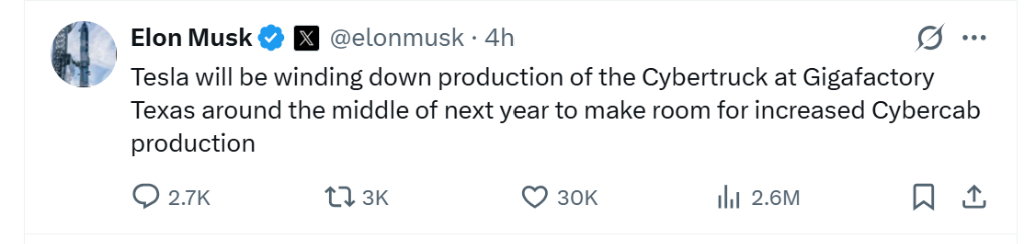
Tesla is winding down Cybertruck production at its Texas Gigafactory around mid-2027, which means the truck's practical selling window comes to about three and a half years. As a purchase decision rather than a headline, the trade-off is unusually blunt: class-leading crash ratings against 11 recalls, a $39,900 promise against a $102,490 exit, winning 2025 volume against Rivian and Chevrolet while losing outright on scale to the F-150 Lightning. Buy the safety case and the utility; do not buy the resale case.
Read as an investor note, the announcement says less about one odd-looking pickup than about how Tesla converts demand signals into capacity. GlobalBizSight CompanyWatch has been tracking that pattern across the same factory floor, and our practical guide to the Cybertruck wind-down and Cybercab pivot in Texas sets out the indicators to watch line by line.
What did Tesla actually decide, and what does it cost a buyer?
Short answer: this is a capital-allocation decision, not a product recall of the model line. Musk said assembly at the Texas Gigafactory would taper off around mid-2027 to free space for Cybercab output, according to Reuters, which also noted that the vehicle had faced repeated recalls and quality problems.
The pricing detail is what makes the timing awkward. The day before Musk broke the news, Tesla raised the truck again: the dual-motor all-wheel-drive configuration moved to $82,490, the Premium configuration to $92,490, and the Cyberbeast flagship to $102,490 — almost double the lowest figure quoted when the vehicle was unveiled. Buyers who took the 2019 reservation with a refundable $100 deposit saw a different truck and a different number.
How did the price ladder climb from $39,900 to $102,490?
The ladder is the cleanest single chart of the whole episode: each step up happened while volume was falling, which is the opposite of how a mainstream pickup normally earns its price.
| When | Configuration | Price | What changed |
|---|---|---|---|
| 2019 launch event | Base / tri-motor flagship | $39,900 / $69,900 | Deposit-only reservations at $100, refundable |
| Late 2023, first deliveries | Entry version | $60,990 | Four years after the reveal |
| February 2026 | Dual-motor all-wheel drive | $59,990 | Musk said the price was “only for the next 10 days” |
| March 2026 | Dual-motor all-wheel drive | $69,990 | Promotional window closed |
| August 2026 | Dual-motor all-wheel drive | $74,990 | Second increase inside six months |
| The day before the wind-down news | All-wheel drive / Premium / Cyberbeast | $82,490 / $92,490 / $102,490 | Exit pricing at the top of the range |
One inference for analysts: a final raise placed hours before a discontinuation announcement is a margin-recovery and inventory-clearing signal, not a demand signal. Treat the $102,490 Cyberbeast sticker as the end of a cost curve, not as evidence that buyers were willing to pay it at scale.
How does it stack up against the EV pickups that are still on sale?
Here the picture is more nuanced than the “failed product” shorthand. On volume, the Cybertruck was the second-best-selling electric pickup in the United States in 2025 with about 20,200 units, behind the Ford F-150 Lightning at 27,307 and ahead of the GMC Hummer EV (15,788, including SUV bodies), Chevrolet Silverado EV (11,275), GMC Sierra EV (7,996) and Rivian R1T (7,416), per Cox Automotive registration data reported by InsideEVs and re-published by Gasgoo. What killed the model was not being outsold by rivals — it was the rate of decline.
| Model | 2025 US sales | Year change | Status today |
|---|---|---|---|
| Tesla Cybertruck | ~20,200 | −48.1% | Wind-down from mid-2027 |
| Ford F-150 Lightning | 27,307 | −18.5% | Battery-electric production ended December 2025; nameplate due back as a range-extender |
| Chevrolet Silverado EV | 11,275 | +51.8% | In sale, growing |
| GMC Sierra EV | 7,996 | +347.2% | In sale, growing |
| Rivian R1T | 7,416 | −33.1% | In sale, refreshed lineup |
The trade-off reads differently by buyer type. If you want the cheapest credible entry into an electric truck, the growing Silverado EV and Sierra EV programmes now look like the safer commercial bet, because those brands are still investing in the segment. If you want volume support — dealer network, parts flow, resale comparables — no electric pickup offers that any more; even Ford abandoned the battery-only Lightning after building it on the best-selling truck nameplate in the country, pivoting toward hybrids and a gasoline range-extender replacement, as WardsAuto and Hagerty reported. Ram likewise cancelled its planned electric pickup. Tesla is exiting a shrinking niche, not losing a race it could still have won.
Why did a 250,000-a-year plan stop at roughly a tenth of that?
The honest answer starts with the reservation funnel. Around the start of production in 2023, Musk had predicted annual sales of 250,000 units, according to Reuters. The truck instead moved about 20,200 units in a full calendar year in the United States, and USA Today reported a further 28% decline in 2026, with volumes running at roughly a tenth of planned capacity.
That gap was visible in the original demand data, if you read it carefully. On launch day, November 21, 2019, Musk staged the shatter-resistance demo; on November 23, 2019 he said reservations had hit 146,000, and a few days later he announced 250,000 within five days of the reveal. Tesla accepted those bookings with a $100 refundable deposit. Within weeks, some buyers were listing their slots on eBay for $1,000 to $8,000 — a tell that a meaningful share of “buyers” were speculating on scarcity rather than intending to order a truck. Deposits are not orders, and a refundable deposit during a hype cycle is closer to a free option.
The contrast case is instructive: Ferrari has taken the opposite route with its first battery car, telling investors its Luce allocation was fully spoken for and that orders placed now wait at least a year — our reading of the Luce order book explains how committed-quantity disclosure differs from reservation counting. For a halo product, the gap between “we have interest” and “we have orders” is the entire valuation question.
What do 11 recalls and one $58,000 repair bill say about owning one?
Conclusion first: the ownership story splits into two very different ledgers — software-fixable defects on one side, structural repair economics on the other.
According to the National Highway Traffic Safety Administration, Tesla has issued 11 recalls against the Cybertruck since the vehicle launched in late 2023, with some vehicles requiring physical repairs and others fixed through over-the-air software updates. The broadest action came in January 2024, when a warning-light font problem swept up more than 2.19 million Tesla vehicles across several models, the Cybertruck among them. In April 2024, 3,878 Cybertrucks were recalled over a loose accelerator pedal pad that could catch interior trim; in March 2025, another 46,096 were recalled over a roof light bar that could delaminate and detach.
The harder number comes from the bodywork. Edmunds ended its long-term Cybertruck test by tearing the truck down for inspection at a cost of $1,128 and receiving a repair estimate of $57,879.89 — a striking illustration of how an unpainted stainless exoskeleton behaves in the real world: panel-level damage cannot be spot-repaired and blended the way conventional painted steel can, so modest collisions escalate into full-panel replacement. Third-party body shops equipped for that work remain scarce.
Residual value follows the same logic. CarEdge models the Cybertruck's five-year depreciation at roughly 46%, leaving an estimated resale value near $50,946 — and a discontinued model typically steepens that curve, since comparables thin out and buyers price in service risk. That is our reading of the published estimates, not a Tesla figure.
The offsetting asset is safety, and it is not trivial. The Cybertruck has earned the IIHS Top Safety Pick+ award, which Teslarati reported in December 2025 as the highest rating given to any pickup in the institute's programme. So the honest verdict for owners is: you hold one of the best-rated crash structures in the segment and one of the weakest repair-and-resale profiles in it.
Where the four-year delay did the real damage
The trouble set in immediately. When Musk unveiled the vehicle at the Tesla design studio in Hawthorne, California, on November 21, 2019, he invited a metal-ball throw at the armoured glass and both windows cracked; the clip spread within hours. Musk later explained on X that sledgehammer blows to the doors during pre-show preparation had already damaged the bottoms of the glass, so the steel ball failed to bounce off. At the delivery event in November 2023, chief designer Franz von Holzhausen repeated the stunt with a baseball and the glass survived.
Analysts and brand specialists had framed the shiny stainless truck, styled after the dystopian look of Blade Runner, as Tesla's chance to rebuild an image strained by the deep price cuts it had used to stimulate demand. Musk also claimed the body would use the same ultra-hard cold-rolled stainless alloy as SpaceX's Starship rocket; Reuters subsequently reported that the two programs actually use closely related but slightly different variants.
Then the schedule slipped. Production was promised by the end of 2021; by August 2021 Tesla had quietly moved it to 2022, disclosed only through a note on the reservation page, and later pushed again to 2023, with Musk blaming supply-chain shortages. The first Cybertruck rolled off the line at the Texas Gigafactory in July 2023, which Tesla characterised as pilot production, and the formal handover took place in Texas on November 30 of that same year, with Reddit co-founder Alexis Ohanian receiving the keys from Musk as one of the first owners. Four years from reveal to delivery; about three and a half years from delivery to the end.
Where buyers and commentators routinely get this wrong
- “Eleven recalls means eleven hardware defects.” Several were remedied by over-the-air updates, and the January 2024 warning-light action covered a fleet-wide population of more than 2.19 million vehicles rather than this model alone.
- “250,000 reservations proved demand.” A refundable $100 deposit, with slots resold on eBay for $1,000 to $8,000, measures attention, not purchase intent.
- “A discontinued model cannot be serviced.” There is no US federal statute obliging automakers to supply parts for a fixed period after a model ends; parts availability is a commercial commitment, as The Truth About Cars has documented. Verify Tesla's actual service and parts plans instead of assuming a legal guarantee — in either direction.
- “Raising prices to $102,490 shows pricing power.” The increase landed the day before the wind-down news, alongside a 2026 sales decline of about 28%; it reads as margin management on a shrinking order book.
Decision guide: three profiles, three different calls
- Current owners. Do not rush a trade. Check open recall status against your VIN — 11 actions to date is a real number to reconcile — and get written confirmation of parts and software support before deciding. If you keep trucks long term and can live with panel-level repair economics, the crash rating is a genuine reason to hold.
- Shoppers eyeing a discounted new unit. Only sensible if you are a keeper rather than a three-year leaser: model the 46% five-year depreciation estimate, not the brochure price. Compare the Silverado EV and Sierra EV directly on service coverage, since those programmes are still expanding.
- Analysts and BD teams tracking Tesla. Watch four indicators: the exact date the Texas line stops; Cybercab capacity conversion; whether a cheaper variant ever returns the entry price toward the $39,900 promise of the 2019 launch event; and used-market spreads versus the Ford F-150 Lightning now that battery-electric production has stopped.
FAQ: the questions readers are actually searching
How long was the Cybertruck really on sale?
About three and a half years counting from deliveries that began in late 2023 — against four years of waiting between the 2019 reveal and that first handover.
How much did the price actually rise?
From the $39,900 base and $69,900 tri-motor figures at the 2019 launch event, to $60,990 at launch, then through $59,990 for the dual-motor version in February 2026 (a price Musk said was valid “only for the next 10 days”), $69,990 in March, $74,990 in August, and $82,490 / $92,490 / $102,490 for the all-wheel-drive, Premium and Cyberbeast tiers respectively.
How many recalls were there?
11, according to the National Highway Traffic Safety Administration, from the late 2023 launch to date; fixes were split between physical repairs and over-the-air updates.
Is the electric pickup segment dying, or just this truck?
Both, partly. Tesla is exiting; Ford ended battery-electric Lightning production in December 2025; Ram cancelled its electric truck plan. Chevrolet and GMC still grew. The surviving argument for an electric pickup is now utility and charging access, not novelty.
Bottom line for CompanyWatch readers: the Cybertruck episode is a case study in how a loud brand signal — 250,000 reservations in five days — can be mistaken for a factory plan, and how pricing that climbs while volume falls ends up resolved by reallocating the line rather than by winning back demand.
References
- Reuters, “Tesla to pull the plug on Cybertruck after years of poor sales” — https://www.reuters.com/business/autos-transportation/tesla-wind-down-cybertruck-production-texas-gigafactory-next-year-musk-says-2026-11-06/
- National Highway Traffic Safety Administration recall records for Cybertruck actions since late 2023
- Cox Automotive registration data, via InsideEVs and Gasgoo — http://app.myzaker.com/news/article.php?m=1769047191
- Edmunds, “Our Tesla Cybertruck Test Ended With a $58,000 Repair Bill” — https://www.edmunds.com/car-news/2024-tesla-cybertruck-damage-long-term-wrapup.html
- CarEdge Cybertruck depreciation model — https://caredge.com/tesla/cybertruck/depreciation
- Teslarati on the IIHS Top Safety Pick+ award — https://teslarati.com/tesla-cybertruck-earns-iihs-top-safety-pick-plus-award/
- WardsAuto on Ford's range-extender replacement for the Lightning — https://www.wardsauto.com/news/ford-scraps-ev-f150-lightning-replacement-erev/807986/
- USA Today on the 2026 sales decline — https://www.usatoday.com/story/cars/shopping/evs/2026-11-06/tesla-cybertruck-production-ending/92639472007/
- The Truth About Cars on the “ten-year parts” myth — https://www.thetruthaboutcars.com/2015/07/orphan-cars-10-year-parts-myth/