
CompanyWatch Q&A: TI, CCStudio and the Agentic AI Bet That Turns Migration Months Into Days
By Julian Campbell · GlobalBizSight CompanyWatch · questions to info@globalbizsight.com
Texas Instruments has opened its CCStudio development ecosystem to industry-standard AI agents that can generate code, configure peripherals, build an application, flash it to the device and debug it. TI's stated payoff: software migration compressed from months to days across general-purpose and real-time MCUs, wireless connectivity devices and radar SoCs. The honest reading is narrower than the headline — the gain is real only where device-specific context can be injected, and it shows up in engineer-months, not in chip revenue.
The long arc behind this announcement is a change in what is scarce. For most of the past decade the bottleneck in embedded product cycles stopped being silicon and started being firmware: a board can be laid out in weeks, while the software that makes it behave ships in quarters, and the people who write it are the most expensive input in the bill of materials. Whoever absorbs that labour gets to keep the customer. TI's move is best understood as an attempt to own part of that labour — not by building a frontier model, but by packaging knowledge its toolchain has accumulated for years and handing it to somebody else's agent.
What exactly did Texas Instruments change inside CCStudio?
Conclusion first: the change is architectural, not cosmetic. TI moved its tooling from code suggestions toward autonomous development, and it did so by feeding device-specific knowledge into the AI tools engineers already use rather than by asking them to adopt a new model.
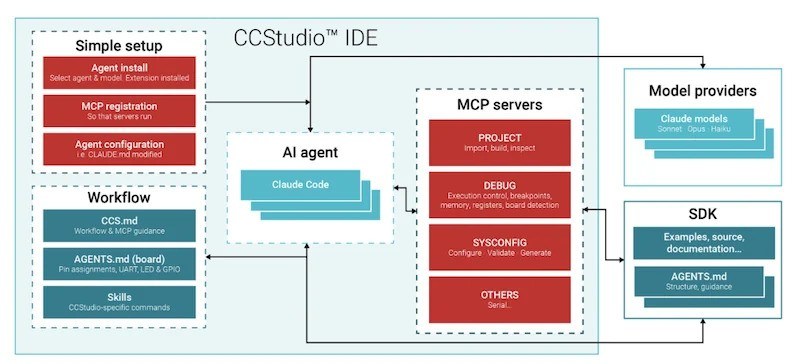
Agentic AI capability in CCStudio spans MCUs, wireless connectivity devices and radar SoCs. Image source: Texas Instruments, via GlobalBizSight CompanyWatch.
Three layers make up the announcement:
- Context injection. SDKs, pin configurations and peripheral data reach the workflow through Model Context Protocol (MCP) servers, which is what lifts accuracy, suppresses hallucinations and makes outputs implementation-ready.
- Execution. CCStudio IDE exposes its core capabilities to industry-standard AI agents, so an agent can generate, configure, build, flash and debug without leaving the environment. The same workflow is reachable from CCStudio for VS Code, in plain language, without switching tools or rebuilding context.
- Specialised subagents for migration. When an engineer asks a preferred AI tool to migrate code, distinct phases are handled automatically: analysing the source project, configuring peripherals, updating code and API calls, then iterating through build errors to resolution while preserving the existing software investment.
Amichai Ron, senior vice president for embedded processing and DLP products at TI, describes embedded software development as an incredibly manual and time-consuming process, and credits agentic AI with changing that over the last few years. His own framing explains why this landed now rather than in the two years since design engineers began using generative AI tools to type code faster: the assistants sped up keystrokes, but stalled on complex embedded tasks because hardware-specific context was missing.
Why is hardware context — not model quality — the binding constraint?
Because embedded code fails on facts, not on fluency. MCP is an open standard, introduced by Anthropic in November 2024, that defines how an AI application reaches external tools and data; on TI's side it becomes the delivery channel for the register maps, pin multiplexing rules and SDK versions a generic model has never seen. Independent engineering coverage of the same announcement, including EE World Online's report on embedded code migration, makes the same point: the target of agentic tooling in this market is a known weakness of general-purpose agents, not a shortage of clever prose.
Two consequences follow. First, the moat is the content, not the agent — which is why TI describes a modular architecture of task-specific skills, MCP server integrations and context injection, designed to keep expanding support for new devices, updated SDKs and emerging edge AI workflows. Second, verification remains the hard part: recent academic work on embedded workflows, such as the 2026 arXiv survey of LLM-assisted embedded testing, argues that verification is increasingly the bottleneck rather than code generation. Third-party benchmarking of agents on embedded integration tasks is only now appearing, for example in the EmbedAgent benchmark published through ACM in 2026. Independent evidence for the months-to-days claim is still thin.
How much of the Texas Instruments business does this actually touch?
Less than the coverage suggests, and that is the point. In the third-quarter 2026 report published on 21 October 2026, TI posted revenue of $6.06 billion, up 28% year over year, with analog at $4.91 billion (up 32%) and embedded processing at $858 million (up 21%), according to the company's investor release. Our own arithmetic on those reported figures puts embedded processing at roughly one-seventh of the quarter — the segment that carries CCStudio is not the segment that carries the P&L.
That mismatch is exactly why the tooling matters. Agents that migrate code while preserving a customer's existing software investment lower the cost of staying, and TI's parts are designed into systems that also consume its analog and power products. The tool is retention infrastructure for the wider portfolio. The layer that gets monetised is not the model; it is whoever owns the context the model cannot function without.
Is this a single-company move or an industry-wide tooling race?
Single-company headlines, industry-wide pattern. Within days of the CCStudio news, the same play appeared elsewhere in the microcontroller market.
| Vendor and tool | What the agent is given | What the buyer is expected to change | CompanyWatch read |
|---|---|---|---|
| Texas Instruments — CCStudio IDE, CCStudio for VS Code | SDKs, pin configurations and peripheral data via MCP servers; subagents for migration phases | Nothing in the editor; agents come from the open market | Deep silicon coverage across MCUs, wireless connectivity devices and radar SoCs; claim not yet third-party benchmarked |
| STMicroelectronics — STM32Cube for Agentic AI, released as a beta in early November 2026 | Manufacturer-supplied STM32 skills, documentation, validated examples and configuration tools | Adopt a beta while quality still depends on the chosen agent and model | Positions itself on lower token cost and fewer hallucinations; see our coverage of STMicroelectronics' unified STM32 platform |
| Hardware-first challengers | Parts and reference designs ahead of software automation | Bring your own tooling | Launches such as GigaDevice's GD32H7 industrial MCU introduction in Munich, Germany show the same week, same city, different priority |
Useful context on the venue itself: electronica is staged 10–13 November 2026 at Messe München, co-located with SEMICON Europa, with the organiser's site listing more than 3,400 exhibitors. TI is demonstrating agentic AI workflows in CCStudio IDE and CCStudio for VS Code at its booth in Hall C4 during electronica 2026, covering end-to-end application development from system configuration to debugging.
What are the misconceptions to avoid in reading this news?
- "Months to days" is a vendor measurement, not an audited one. TI states it; no independent benchmark cited in the announcement confirms it. Treat it as an upper bound on simple, well-covered migrations.
- Autonomous does not mean unsupervised. Interrupt latency, real-time scheduling, functional-safety constraints and hardware revision differences are precisely where agents trained on desktop and web patterns misfire, and they remain human sign-off items.
- This is not an AI revenue story. Embedded processing sells components; the agent layer is a switching-cost argument, so judge it on design wins and migration volume, not on software licence income.
- Context injection is bounded by TI's own silicon. Workloads spanning multiple vendors' parts still need a plan for whichever vendor does not publish an MCP server.
- Availability today is not a settled commercial term. Nothing in the announcement prices the agentic features, and ST's comparable beta is a reminder that quality can depend on the agent and model a team selects.
What should a design team or investor do next?
- Pick one migration you were already going to do — a mid-priority board with a stable SDK — and run it in parallel with your manual estimate.
- Baseline the labour honestly: engineer-weeks, defect escapes and re-spin costs before adoption, so the months-to-days claim becomes your number rather than TI's.
- Verify context coverage for the exact part numbers you use, since capability is distributed across general-purpose and real-time MCUs, wireless connectivity devices and radar SoCs unevenly by SDK.
- Keep human review mandatory for timing-critical, safety-related and production-release code paths; scope the agent to configuration, porting and first-pass bring-up.
- Put data flow and IP handling in writing before source code touches any agent, and confirm which parts of the workflow run locally versus through external services.
- For investors, read the tooling news against segment disclosure rather than headlines, using TI's quarterly reporting on its investor site as the baseline.
Frequently asked questions
What is agentic AI in CCStudio, in one line?
It is an AI workflow that can act on TI's development environment — generate, configure, build, flash, debug — instead of only suggesting code, with device-specific knowledge injected through MCP servers.
Do engineers have to change editors?
No. The capability is exposed inside CCStudio IDE and inside CCStudio for VS Code, so a team keeps its current habits and its existing software investment. The underlying environment is built on a framework with a VS Code-style experience, which is why the split is low-friction.
Which TI products does it cover today?
Agentic AI capabilities in CCStudio are available across TI's general-purpose and real-time MCUs, wireless connectivity devices and radar SoCs, on a modular architecture designed to add devices and updated SDKs over time.
How do I see it working rather than read about it?
The live demonstration runs at electronica 2026 in Hall C4, at Messe München from 10 to 13 November 2026, showing end-to-end development from system configuration to debugging.
Is the months-to-days number verifiable?
Not yet, from public sources. It is TI's own characterisation of migration time; independent embedded-agent benchmarking is only beginning to appear. Run a controlled pilot before assuming it applies to your code base.
Which indicators tell us whether this is working?
- Device and SDK coverage lists — how many part families gain MCP support per quarter, and how quickly updated SDKs appear.
- Whether TI or an independent lab ever publishes a migration benchmark with hours, defect rates and re-spin counts.
- Embedded processing revenue growth versus analog growth in TI's quarterly reports, as a proxy for whether tooling is pulling the wider portfolio through.
- Developer-forum failure reports: build-loop iterations, peripheral misconfiguration and agent quality when the model is swapped.
- Pricing and terms — whether the agentic layer stays bundled with the toolchain or becomes a paid line item.
- Competitive response — whether other MCU vendors publish their own MCP servers or restrict third-party agents from their environments.
- Regulated-sector uptake, where production deployment historically trails consumer software by years rather than months.
For the decision layer: judge CCStudio's agent capability as a procurement term, not a feature. Ask the vendor for the migration baseline, put context coverage and exit costs in writing, and let one parallel pilot convert a marketing claim into an operating number you can defend.
References
- TI third-quarter 2026 results and shareholder returns — investor.ti.com
- EE World Online, "Agentic AI takes on embedded code migration"
- Anthropic, "Introducing the Model Context Protocol" (November 2024) — anthropic.com/news/model-context-protocol
- STMicroelectronics, STM32Cube for Agentic AI product page — st.com
- electronica 2026 event dates and venue — electronica.de
- arXiv (2026), LLM-assisted embedded software testing; EmbedAgent benchmark via ACM Digital Library