
GlobalBizSight CompanyWatch Q&A: What Tiger Brokers' Three-Agent OOH Pilot With Adzymic and Stellar Ace Really Proves
By Ethan Rivera · GlobalBizSight CompanyWatch
Short answer: it proves the coordination layer of an outdoor campaign can be automated — not the judgement. Between 21 October and 3 November 2026, Tiger Brokers, Stellar Ace and Adzymic ran a live out-of-home campaign across more than 260 digital screens in Singapore in which three AI agents handled media planning, sales-side evaluation and creative production, while people kept sign-off on the buy and the brand.
For a retail brokerage whose Singapore book is compounding quickly, the pilot is less a marketing flourish than a stress test of where cycle time and headcount sit inside a media buy. This CompanyWatch Q&A treats the campaign as a company event — what changed, why now, where the risk sits, and which signals are worth tracking over the next four quarters.
What exactly did the three partners put live?
The partners frame it as Asia's first live agentic OOH deployment: a real advertiser, real inventory and real money, rather than a simulated demo. The campaign was staged to promote Tiger Brokers' annual flagship event, “Tiger Trade Experience 2026”, and ran for a two-week window from 21 October to 3 November 2026 across more than 260 digital advertising screens in Singapore.
The scale context matters more than the headline. Mordor Intelligence sizes Singapore's OOH and DOOH market at USD 206.30 million in 2026, growing at a 6.13% CAGR to USD 277.78 million by 2031 (Mordor Intelligence), with digital formats taking a rising share of that pool. A 260-screen, two-week test is modest in absolute media terms — but it touches the part of the workflow where labour, not inventory, is booked.
On the supply side, Stellar Ace describes itself as Singapore's largest OOH operator, with more than 15,000 media assets, over 1.3 billion potential weekly impressions and 85% weekly reach of the population (stellarace.com.sg). Holding creative consistency across a network that wide is precisely the manual task the pilot set out to compress.
Why would a retail brokerage test agentic buying at all?
Because acquisition velocity, not advertising novelty, is the driver. Tiger Brokers Singapore disclosed a record second quarter in 2026: group revenue of US$182.3 million, up 31.4% year on year; client assets of US$60.7 billion, up 16.7%; and Singapore trading volume up 92% year on year, with total orders up 46% and US stock volume up 114% quarter on quarter (Tiger Brokers Singapore, 26 August 2026). The brokerage also extended US options trading to Singapore investors on 2 November 2026, mid-campaign (Tiger Brokers Singapore newsroom).
When the client base and the product surface expand that fast, media becomes a throughput problem: more audience segments to reach, more screen formats to fill, more approval cycles to clear. Agentic tooling appeals for an unglamorous reason — it attacks the queue between brief and live screen.
How does the three-agent loop actually divide the work?
Read the architecture as a handoff chain with three checkpoints rather than one model doing everything:
- Buyer agent. Examines Stellar Ace's media inventory and puts forward a media plan shaped by Tiger Brokers' requirements.
- Sales agent. Evaluates that plan on behalf of the media owner, removing the manual coordination otherwise needed between the two sides.
- Creative agent. Reads Tiger Brokers' brand guidelines alongside individual screen specifications and generates creatives suited to the different formats.
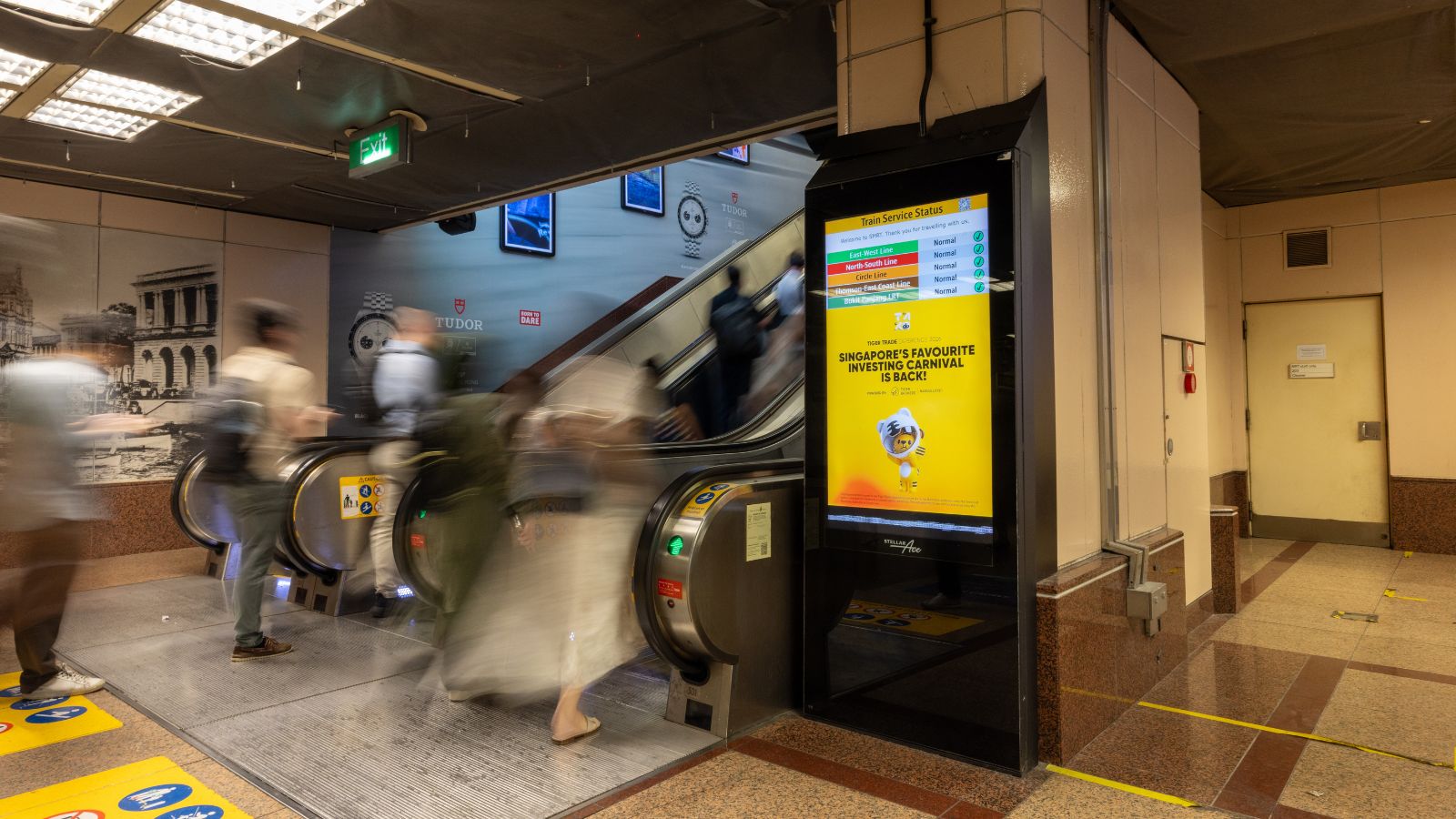
The timing of the underlying infrastructure is the detail most coverage missed. Adzymic announced its AgenX Sales Agent on 18 October 2026, opening premium Singapore inventory to AI buyers (Marketing-Interactive, 21 October 2026) — the same week the Tiger Brokers campaign went live. The pilot was therefore not an experiment bolted onto an existing stack, but the first commercial use of a platform the vendor had just shipped.
Tony Heng, president of Stellar Experience, framed the work as an ecosystem question rather than a technology one. “Agentic advertising presents an opportunity to move towards a more connected advertising ecosystem. We are in an era of advertising where planning, buying, and delivery can be fundamentally transformed. Speed, agility and accountability will define how we deliver value,” he said. “This pilot, conducted for a real campaign with a real advertiser and actual OOH inventory is a huge step in Stellar Ace's move towards AI-enabled OOH advertising,” he added.
Kenniess Wong, co-founder and executive director of Adzymic, positioned it as staged build-out: “Earlier this year, we started building agentic infrastructure for advertising. With Tiger Brokers and Stellar Ace, we put it to work on a live OOH campaign,” he said. “This is a first step towards what we set out to build: intelligent agents working together across the advertising value chain, so teams can spend their time on judgement rather than coordination,”
That last line is the honest version of the value claim. The pitch is not fewer people; it is people moved off chasing status updates and onto making calls.
Where does the human veto sit, and what breaks first?
Three assumptions do most of the damage when teams evaluate a pilot like this one.
- “The agents ran the campaign.” They did not. Tiger Brokers reviewed and approved the proposed media plan before Stellar Ace accepted the media buy, and both teams carried out creative checks and handled the operational requirements needed to take the campaign live. Commercial decisions, brand suitability and campaign delivery stayed with people.
- “Agentic OOH is programmatic with a new label.” The difference is the unit of work. Programmatic executes predefined rules against inventory; an agent interprets a campaign objective, weighs available information and coordinates tasks across stages. That is a different failure mode, with a different audit trail.
- “Automation means a lower cost.” What falls away is coordination labour; what rises is governance. McKinsey's agentic AI playbook argues that autonomous systems need guardrails, permissioning and monitoring designed in from the start, and legal analysts warn that agentic advertising can widen exposure to consumer-protection and false-advertising rules precisely because human review thins out (Davis+Gilbert).
Stellar Ace's network numbers add a fourth pressure point. At 1.3 billion potential weekly impressions across 15,000+ assets, one badly generated creative variant is not a rounding error — it is an error at population scale. Screening and rollback capability matter more than generation speed.
What should operators copy, and what should they skip?
The transferable asset is the process design, not the vendor stack. A five-check filter for any team weighing a comparable run:
- Anchor it to a dated, bounded campaign. The credibility came from the window — 21 October to 3 November 2026 — and a single flagship objective, Tiger Trade Experience 2026.
- Keep buy approval human and named. The agent proposes; a person signs. Nothing in the pilot removed that step, and nothing should.
- Feed the creative agent a real specification set. Screen dimensions plus brand guidelines are what make generated variants usable rather than decorative.
- Instrument the three handoffs. Brief to media plan, plan to acceptance, creative brief to approved asset. Those queues are where agentic workflows earn their keep.
- Fix the audit trail before launch. Who reviews what, in what order, and what gets logged when an agent's output is rejected.
Ernest Teh, marketing director of Tiger Brokers Singapore, kept the conclusion deliberately measured: “At Tiger Brokers, we are always looking for innovative ways to engage our audiences more effectively. This agentic pilot has been an encouraging experience, demonstrating the potential for AI to streamline media planning and we see the potential for agentic AI to transform how brands plan and activate our advertising campaigns in the future,” he said.
Note what the quote does not contain: no cost saving, no conversion lift, no attribution result. For an analyst that absence is itself a data point. The pilot was scoped to prove process feasibility; the efficiency numbers are still owed.
Does the 2025 offline run explain the 2026 bet?
The screen test did not arrive out of nowhere. Last year, Tiger Brokers Singapore hosted its flagship “Tiger Trade Experience 2025: What's your secret sauce” event at Plaza Singapura, drawing more than 4,000 attendees over two days. Ahead of it, the brokerage launched an online quiz that sorted investors into different trading personalities, among them 'Salt', 'Wasabi' and 'Sambal Chilli', to drive engagement and attendance.
The activation turned Plaza Singapura's atrium into “Tastemakers corp”, a finance-themed experiential space with interactive missions, trading tools and games. Visitors could explore the Tiger Innovation Lab, take part in giant Jenga and a human claw machine at Tiger PLAYce, and win limited-edition merchandise.
Read the two campaigns together and the pattern is a company systematically testing where offline attention becomes funded accounts — first physical experience segmented by investor personality, now machine-coordinated screen inventory. The through-line is not AI. It is a distribution machine that has to keep getting cheaper per acquired investor.
FAQ: the questions decision-makers are actually asking
Did AI agents replace the media agency or the sales team?
No. The pilot compressed coordination between advertiser and media owner, but approval of the media plan and the creative checks stayed with Tiger Brokers and Stellar Ace teams. Agents drafted and proposed; people committed budget.
Is agentic OOH available outside Singapore yet?
Not at this scale. The campaign drew on Stellar Ace's Singapore inventory and Adzymic's platform, and the partners describe it as a first step rather than a rollout. The test for other markets is supply-side: whether local media owners expose premium inventory to agentic buyers at all.
How is this different from programmatic DOOH?
Programmatic automates the transaction against targeting rules. Agentic workflows automate the reasoning before the transaction — reading a brief, scanning inventory, proposing a plan, adapting creative. The transaction layer can look identical while the labour saved sits upstream. If the deeper question is whether these tools shift decision rights into marketing teams or simply relocate the coordination work, our CompanyWatch Q&A on RudderStack Lookout traces the same tension in audience building.
What did it cost, and is it cheaper?
No cost figures were disclosed, and any percentage-saving claim should be treated as unverified. OOH pricing depends on screen mix, duration and location tier, so cross-campaign comparisons are rarely apples to apples. The metric worth demanding is cost per approved creative asset and cost per cleared buy cycle.
What should investors and analysts track over the next four quarters?
Three signals: whether Tiger Brokers Singapore runs a second agentic buy without vendor co-marketing; whether Adzymic publishes client or volume figures for AgenX; and whether Stellar Ace books agentic campaigns inside reported OOH revenue mix. Vendor case studies are cheap; repeat usage is not.
The pattern is already visible in adjacent categories, where our CompanyWatch Q&A on TI and CCStudio tracked how standard agents compress migration work that used to take months. The logic transfers: agentic tooling earns its place when it removes a queue someone was already paying for.
Sources and verification trail
- Marketing-Interactive, “Adzymic opens Singapore ad inventory to AI buyers”, 21 October 2026 — marketing-interactive.com
- Adzymic, “Adzymic Launches Sales Agent, Making Premium Inventory in Singapore Available”, 18 October 2026 — adzymic.co
- Mordor Intelligence, Singapore OOH and DOOH market sizing — mordorintelligence.com
- Stellar Ace, network and reach figures — stellarace.com.sg
- Tiger Brokers Singapore, Q2 2026 results post, 26 August 2026 — linkedin.com
- Tiger Brokers Singapore newsroom, extended-hours US options, 2 November 2026 — itiger.com
- McKinsey & Company, “Deploying agentic AI with safety and security” — mckinsey.com
- Davis+Gilbert, “Agentic AI in Advertising: Five Legal Risks Marketers Cannot Ignore” — dglaw.com
For decision-makers: the only question that matters over the next four quarters is narrow — can the sign-off layer get faster without getting thinner?
Corrections and tips: info@globalbizsight.com