
Silicon Carbide Business Models Compared: IDMs, Open Foundries and One Bulgarian Bid | GlobalBizSight SectorDeepDives
Which silicon carbide business model deserves capital right now? On the numbers, the vertically integrated IDM still controls roughly 90% of device revenue; the open pure-play foundry is real but thin; the state-backed new-location fab works only if capacity is phased against signed orders. The fastest-growing demand pool has moved from European cars to AI data-center power, where SiC sits upstream and GaN sits beside the processor. Below is a side-by-side test of those three models.
That scoring comes out of a single week. Last week, the Green Semiconductors Investment Forum in Sofia put all three bets in one room. Held under the patronage of the Bulgarian government and the British Embassy, the forum centered on an initiative to establish Green Silicon Carbide Manufacturing (GSCM), a SiC fab in Bulgaria designed as an integrated device manufacturer, while the investors' panel spent most of its time on the startup ecosystem's missing piece: open capacity. What follows are the comparisons that emerged from GSIF 2026, plus figures assembled afterwards on the European and global scene.
What silicon carbide is, and why its résumé drives the buying decision
Start with the definition, because it explains the business model. In 1891, Edward Acheson, once an assistant to Thomas Edison, used an electric arc to heat clay and carbon while trying to produce artificial diamonds. He got small, hard, blue-black crystals instead, and called them carborundum. Two years later, the French chemist Henri Moissan, hunting for diamonds in meteorite fragments from Arizona, found the same substance in nature; the mineral was later named moissanite after him.
| Era | Use SiC was sold for | What that era proved |
| Most of the 20th century | Industrial abrasive, nearly as hard as diamond | Bulk, cost-insensitive demand |
| 1907 | Early radio detector; the crystal in which electroluminescence was first observed | SiC as an active electronic material |
| Late 1990s | Synthetic gemstone, grown by Cree, the company later renamed Wolfspeed | Crystal growth at commercial scale |
| Today | Power devices inside electric cars, and now data-center power chains | The repeatable revenue pool |
The history is not decoration. At the Sofia forum the speaker closed his remarks by noting that 130 years later a room full of entrepreneurs and investors was still trying to turn silicon carbide into diamonds — and still could not say which application pays next. For a purchasing or portfolio decision, that résumé is the risk model: each SiC market has been created by a process learning curve, not by a design win.
Which demand pool pays first: cars, grids, or AI racks?
The demand story remains solid, but the three pools are not equally investable. Yole Group's Poshun Chiu, who presented in Sofia, expects wide-bandgap power devices (SiC and GaN together) to pass $14 billion by 2031, growing at around 22% a year. Yole's June 2026 update splits that pool further: the power SiC device market alone is put at about $11 billion by 2031 on a 20% CAGR from 2025, which implies GaN carries only a few billion dollars — and most of it in the conversion stages closest to the processors (Yole Group).
| Demand pool | What SiC is actually bought for | 2026 signal | Decision note for buyers |
| Electric vehicles | 800V traction inverters: range, charge time, package size | Yole expects the share of battery electric vehicles using 800V architectures to grow from about 12% in 2025 to roughly half by 2031 | Largest volume, fiercest price war; qualify on total system cost, not device price |
| Renewables, storage, wind | Higher-voltage converters and protection | Keeps growing steadily through the downturn | Underpriced stability; fewer qualification gates than automotive |
| AI data centers | Redesigning the power chain around 800V DC, with SiC moving upstream toward the grid connection — power shelves and, later, solid-state transformers fed at 10 to 20 kV | Nvidia has said its 800 VDC architecture is built for 1 MW IT racks and beyond, starting in 2027 | Highest strategic value, longest sales cycle; today it is a design-in bet, not a volume order |
On the data-center leg, the engineering case is now documented rather than asserted. In Nvidia's own technical write-up, raising rack distribution voltage improves end-to-end power efficiency by up to 5% against conventional 54 V racks; Wolfspeed's research team argues that 1200 V SiC MOSFETs at the AC-DC and DC-DC steps cut conversion losses by 25-40% and maintenance costs by around 70%, and cites International Energy Agency warnings that roughly one in five planned data-center projects faces grid-connection delay, with medium-voltage transformer lead times stretching to three years. That last point is why SiC is moving upstream toward the substation rather than downstream toward the GPU.
Competition, meanwhile, is brutal at the substrate level. According to TrendForce, Chinese producers have pushed six-inch SiC substrate prices from around $1,500 to $500 or less. TrendForce's earlier coverage showed how fast the curve broke: 8-inch quotations in China fell from roughly $3,000 to $4,000 per piece at the end of 2023 to about $1,500 by October 2024, while the same analysts sized the wafer-size prize at a 50% unit-cost step from 4-inch to six-inch and a further 35% from 6-inch to 8-inch (TrendForce). By the first quarter of 2026 six-inch prices were down more than 30% year on year even as combined 6-inch and 8-inch shipments rose 3.58% quarter on quarter. Volume up, price down: the binding constraint is utilization, not demand.
What does building capacity ahead of demand cost? Wolfspeed's arithmetic
Nothing tests the SiC business model harder than Wolfspeed, the long-time market leader. It filed for Chapter 11 in June 2025, reportedly carrying about $6.7 billion of debt, much of it raised to build new fabs ahead of demand. After re-emerging with 70% less debt, it is clearly recovering, but slowly.
In its latest quarter, to September 2026, it still reported a negative gross margin of about 13% (non-GAAP). Management called underutilization the main drag on margins and said that running the new Mohawk Valley fab at around 25 to 30% of capacity would be enough to reach gross-margin breakeven, which suggests it currently runs below that level (earnings call). It expects to approach gross margin breakeven this quarter, helped by AI data center demand, its fastest-growing market, and in October it secured a conditional $1.5 billion loan commitment from the U.S. Department of War, a sign of how strategic SiC has become.
Read as a comparison rather than a news item, the numbers say three things. First, an anchor customer is not insurance: Renesas prepaid about $2 billion for wafer supply, and the company still failed. Second, the breakeven lever is a utilization percentage, not a technology milestone — which matches Yole's estimate that 2025 utilization ran near 50% upstream and about 70% for device processing, with overcapacity persisting into 2027-2028. Third, state money has become part of the capital structure in the U.S., and increasingly elsewhere.
IDM, open foundry, fabless startup or in-house OEM: who should own the process?
For silicon, design and manufacturing have been separated for decades, with Nvidia and TSMC the best-known proof that the split works. In SiC that split has not happened: almost all of the business, maybe even 90%, sits inside integrated device manufacturers, because there the process largely is the product — device performance and reliability depend on process details that are hard to separate from the design.
Jen Walls, CEO of Clas-SiC, a boutique SiC foundry in Scotland, put the barrier plainly in her talk: capital can buy the cleanroom, the tools and the wafers, but it cannot buy the learning curve of yield, reliability history and customer qualification, which builds up batch after batch.
| Model | Share of the value pool | Hard constraint | Best fit |
| Vertically integrated IDM (ST, Infineon, Bosch, Wolfspeed) | Dominant; about 90% of SiC business | Must fund the whole learning curve and absorb price wars | Buyers who need qualified, automotive-proven supply |
| Open pure-play SiC foundry | Very small and fragmented | Capacity is scarce; per-class process libraries are thin | Fabless device startups, research teams, niche voltage classes |
| Fabless SiC startup | Design-only | No neutral capacity to tape out into; qualification risk sits with the startup | Niche high-voltage parts, radiation-hardened devices for space, sensors for harsh environments |
| System maker designing in-house | Growing | Needs an IDM partner or a foundry it can trust not to compete with it | Hyperscalers and carmakers with volume and patience |
The scarcity claim is testable. As far as the record shows, neither TSMC, GlobalFoundries, nor Tower offers SiC. The credible open options amount to a short list: X-FAB in Lubbock; a few Taiwanese players announcing 8-inch SiC lines; research lines such as Fraunhofer IISB; and Clas-SiC, which recently announced a £12 million (~$16 million) expansion. Clas-SiC — described by UK Research and Innovation as the world's first dedicated open 150mm pure-play SiC power foundry — runs device classes from 650 V up to 3.3 kV, which is precisely the higher-voltage territory where automotive price competition is thinnest.
Yole's map of the European supply chain makes the same point visually: strong IDMs, very few foundries, few packaging and power module players, and little direct engagement from end-system makers. If open capacity existed, a layer of independent businesses would grow around it — gate drivers, power modules, test, reliability, design kits — as happened in silicon.
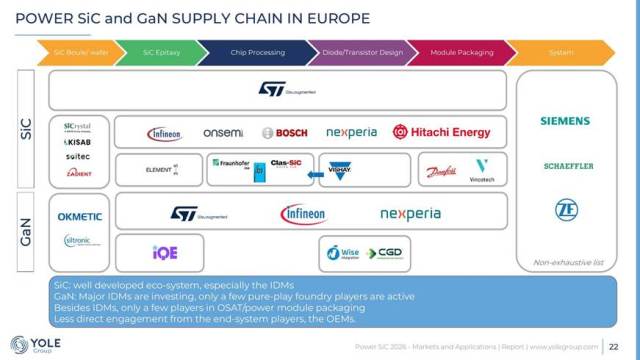 The power SiC and GaN supply chain in Europe (Source: Yole Group, presented at GSIF 2026, Sofia)
And some customers are already halfway there. Tesla designs its own SiC power modules and buys the chips, and in 2023 it announced it would cut its SiC use by 75% through design changes (CNBC) — a reminder of how much leverage a system company holds over a device supplier. If a hyperscaler or a carmaker eventually decides to design its own SiC devices, as many did with digital chips, the sensible target is a neutral foundry rather than an IDM that competes with it.
Europe's paradox: sovereignty by ownership, but not by location
The sharpest finding at Sofia is an internal contradiction. Yole data show that European companies — ST, Infineon, Bosch and others — hold roughly half of the global SiC device market. They are much weaker upstream, with only about 10% of the substrate market, and Europe itself is a small market for SiC in cars, around 12% of global demand against about 63% for China.
Yole also showed a map of more than $30 billion in announced SiC investment as of mid-2026. Re-sorting that map by the headquarters of the investing company rather than the location of the target investment — the cut that matters for European policy — GlobalBizSight's rough tally is that about half of the money comes from European companies, but only around 40% of that money is actually being invested in Europe, mostly in ST's campus in Catania.
| Company | Project location | What the siting decision signals |
| Infineon | Kulim, Malaysia | Back-end ecosystem, lower cost, energy price |
| Bosch | Roseville, California | U.S. demand and U.S. subsidy pull |
| X-FAB | Lubbock, Texas | Open capacity placed near a low-cost, high-voltage customer base |
| ST | joint venture with Sanan in China | Follow the largest demand pool outright |
| Vishay | Newport Wafer Fab, Wales (bought in 2024) | The exception that proves the rule |
Chinese and Japanese companies, by contrast, invest almost entirely at home, and U.S. companies mostly do. The logic is demand, subsidies (the U.S. CHIPS Act made American sites attractive) and energy prices, which matter enormously for a material whose crystal growth is extremely energy-intensive. Yole goes further, seeing Southeast Asia becoming the next power SiC hub thanks to Malaysia's established back-end ecosystem, lower costs, government support and geopolitical neutrality, with Infineon's Kulim fab as the anchor. Europe therefore ends up with sovereignty by ownership, but much less sovereignty by location — which is what counts if supply chains break.
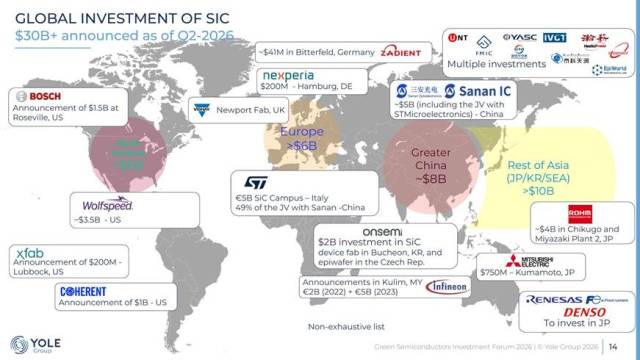 Announced SiC investment by company and location: more than $30 billion as of Q2 2026 (Source: Yole Group, presented at GSIF 2026, Sofia)
Where the €34 billion went, and what that says about new entrants
The European Commission's presentation in Sofia added the policy view. It listed 19 first-of-a-kind production projects approved for state aid under the Chips Act since 2023, worth more than €34 billion in total. Eleven of them are in Germany, and most of the rest are in Italy, France and Austria, while almost none is in Europe's peripheral countries. The single exception on the list was onsemi's SiC expansion in Rožnov, Czech Republic. However, just three days after the forum, onsemi and the Czech government announced that it will not go ahead, citing changes in the SiC market and in the project's economics.
The same slide carried a rule change that is easy to miss: before the Act, state aid for fabs was limited to assisted regions, so the old rule was a relative advantage for places like Bulgaria; opening aid to the wealthier core moved the money there. The Commission's own Chips Act page shows the pattern continuing in 2026, including a €659 million German state-aid approval for four semiconductor facilities announced in July. In summary, Europe has become quite good at financing upgrades by incumbents, and much less good at financing new entrants.
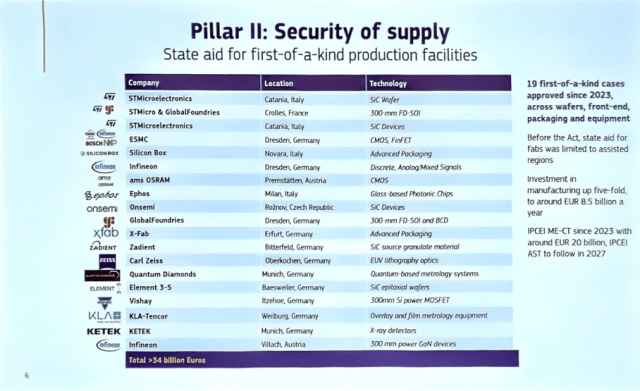 First-of-a-kind production facilities approved for state aid under the EU Chips Act since 2023 (Source: European Commission, presented at GSIF 2026, Sofia)
This is consistent with how the European Investment Bank describes its own role. As EE Times reported earlier this year, the EIB is a lender that screens for cash flow, debt capacity and execution risk, and strategic importance comes on top of bankability, never instead of it. Chips Act 2.0 is the obvious place to revisit the balance between the two — and the European Commission's policy page for the revised act is where that argument will be settled. If cohesion is not part of that discussion, peripheral sites will keep losing on the only variable they control: cost of capital.
Can an emerging location win? Scoring Bulgaria's GSCM bid
The Bulgarian initiative, promoted by Bulgarian-born Prof. Asen Asenov, who has spent the past three decades at the University of Glasgow, starts from a better place than a first look suggests.
| Investability test | What Sofia already has | What is still missing |
| Engineering depth | A fairly large Sofia team at GlobalFoundries, primarily PDK engineers; Belgium's Melexis with around 700 employees in Sofia; Milara, a Bulgarian-American company with engineering and manufacturing in Plovdiv, building wafer-handling robots used in semiconductor equipment worldwide | Volume manufacturing management for a crystal-growth-heavy process |
| Technology access | Clas-SiC for the SiC technology license, Synopsys and SemiWise for PDK development, Milara for process automation | Yield and reliability history, which no license transfers |
| Phasing | Design as an integrated device manufacturer | Capacity built in steps as customers sign, as Infineon is doing in Villach, rather than all at once |
| Customer base | EU state-aid architecture | Orders beyond European cars, toward wind, grid, storage and data center power, where higher-voltage devices face less of the price war |
| Ecosystem openness | Startup-ecosystem representation on the forum panel | Leaving the door open to fabless companies' innovations |
The verdict: the talent stack is credible, the partner stack is credible, and the demand stack is the open question. That is a siting argument, not a technology argument — which is why phasing matters more than subsidy size.
Five misconceptions that misprice SiC decisions
- "Substrate price collapse means demand collapse." Shipments rose while prices fell; the problem is utilization and the pace of Chinese capacity release.
- "State aid selects the best fab." Aid follows bankability. The EIB screens cash flow first and strategic importance second.
- "An anchor customer makes a greenfield fab safe." Wolfspeed had Renesas' roughly $2 billion prepayment and still went through Chapter 11.
- "SiC will be commoditized by foundries, as logic was." No merchant silicon foundry offers SiC today, and the process is the product.
- "The next SiC market will look like the last one." Automotive content per vehicle can be cut by design, as Tesla showed with a 75% reduction pledge; the pool is not fixed.
Action recommendations by role
- Component buyers: lock substrate and device supply on utilization-linked terms rather than flat volume discounts, and qualify a second source in the 8-inch class before the next tightening, since wafer-size economics are the cheapest structural cost lever (about 35% unit cost from 6-inch to 8-inch).
- Device startups: before anything else, know which customer is going to pay for the technology you are developing, then design to a voltage class (1.2 kV to 3.3 kV) where the automotive price war does not reach.
- Fabs and investors: underwrite breakeven as a utilization percentage, not a technology milestone; Wolfspeed's own guidance puts the threshold at 25 to 30% of capacity.
- Regional promoters: compete on phasing, energy price and PDK depth rather than on subsidy headline numbers — the onsemi outcome in the Czech Republic shows how quickly a headline collapses into a cancellation.
Frequently asked questions
Is silicon carbide still primarily an electric-vehicle story?
Yes in volume, no in marginal growth. Automotive remains the anchor, with 800V architectures moving from about 12% of battery electric vehicles in 2025 toward roughly half by 2031, but the fastest-moving narrative at GSIF 2026 was AI data centers, where SiC is being pulled upstream toward 800V DC distribution and solid-state transformers.
Why can't a fabless SiC designer simply use TSMC?
Because there is no silicon-style separation available. Neither TSMC, GlobalFoundries, nor Tower offers SiC; open capacity is limited to X-FAB's Lubbock site, a handful of Taiwanese 8-inch announcements, research lines such as Fraunhofer IISB, and Clas-SiC.
Does SiC compete with GaN in the same socket?
They split the stack. GaN takes the conversion stages closest to the processors; SiC, with its higher voltage block capability, moves toward the grid connection at 10 to 20 kV. A design that assumes one of them wins the whole pool will misprice both.
Is a new SiC fab in Europe still financeable?
Only if it is phased and non-automotive-centric. The European Commission list shows 19 approved projects and more than €34 billion, concentrated in Germany and a few core states, and the one peripheral exception was cancelled three days after the forum.
Could the next SiC market be something nobody sells yet?
That is the honest tail risk. A recent review by researchers at Singapore's A*STAR Institute of Microelectronics describes SiC as a promising platform for photonic and quantum chips, largely because it can be processed in standard CMOS fabs, although the field is still at an early research stage. Investors do not finance surprises, especially not for a fab; they finance a customer today, while research for the next reinvention continues in parallel and, if possible, separately.
The 135-year verdict
Silicon carbide has been an abrasive, a detector, a light source, a gemstone and now a power switch. Over 135 years it has surprised us several times, and its next uses may surprise us again — but the comparison across models is not close: the IDM wins today on learning curve, the foundry wins on optionality, and the new-location fab wins only if it phases capacity against named orders. Acheson never made his diamond. The material he found instead turned out to be worth much more, and it took more than a century and several false starts to find out how.
Sources and further reading
- Yole Group, "Power SiC enters the AI age", June 2026 — https://www.yolegroup.com/press-release/power-sic-enters-the-ai-age/
- Nvidia developer blog, "NVIDIA 800 VDC Architecture Will Power the Next Generation of AI Factories" — https://developer.nvidia.com/blog/nvidia-800-v-hvdc-architecture-will-power-the-next-generation-of-ai-factories/
- Wolfspeed knowledge center, silicon-carbide solid-state transformers for AI data centers (IEA grid-connection and transformer lead-time references) — https://www.wolfspeed.com/knowledge-center/article/powering-ai-with-reliable-silicon-carbide-based-solid-state-transformers/
- TrendForce, 6-inch oversupply and substrate price coverage (October 2024) — https://www.trendforce.com/news/2024-10-23/news-oversupply-of-6-inch-sic-substrate-leading-to-price-decline/
- TrendForce, China wide-bandgap divergence and Q1 2026 pricing — https://www.trendforce.com/news/2026-05-14/news-chinas-wide-bandgap-chip-players-diverge-as-gan-rf-surges-sic-profitability-under-pressure/
- UK Research and Innovation, Clas-SiC open 150mm SiC foundry case study — https://www.discover.ukri.org/clas-sic-case-study/index.html
- European Commission, Chips Act 2.0 policy page — https://digital-strategy.ec.europa.eu/en/policies/chips-act-2
- GlobalBizSight SectorDeepDives, "What Europe's 2026 Chip Crisis Cases Teach About Chips Act 2.0" — https://globalbizsight.com/sectordeepdives/europe-2026-semiconductor-storm-path