
GlobalBizSight CompanyWatch Checklist: How to Track Hongkong Land's LANDMARK Orchard Rollout
By Isla Sanders, GlobalBizSight CompanyWatch
The short answer: the 12 November rename of Wheelock Place to LANDMARK Orchard is a capital-markets event wearing a brand's clothes. Judge it on three trackable numbers — the SCPREF fund's assets under management, rent reversion at the asset, and Hongkong Land's net debt — rather than on the adjectives in the press release.
For most of the past two decades, the dominant playbook for Asian commercial landlords was to hold trophy buildings on the balance sheet, borrow against the revaluations and let the rent roll do the talking. The model now visible at Hongkong Land runs the other way: keep the operating capability in-house, place the bricks inside a perpetual fund, earn fees on capital that is largely not your own, and make the brand the reason a tenant renews. That move from owner to owner-manager is the long trend this story sits inside, and it is why a nameplate change in Singapore deserves a CompanyWatch file.
What actually changed on 12 November?
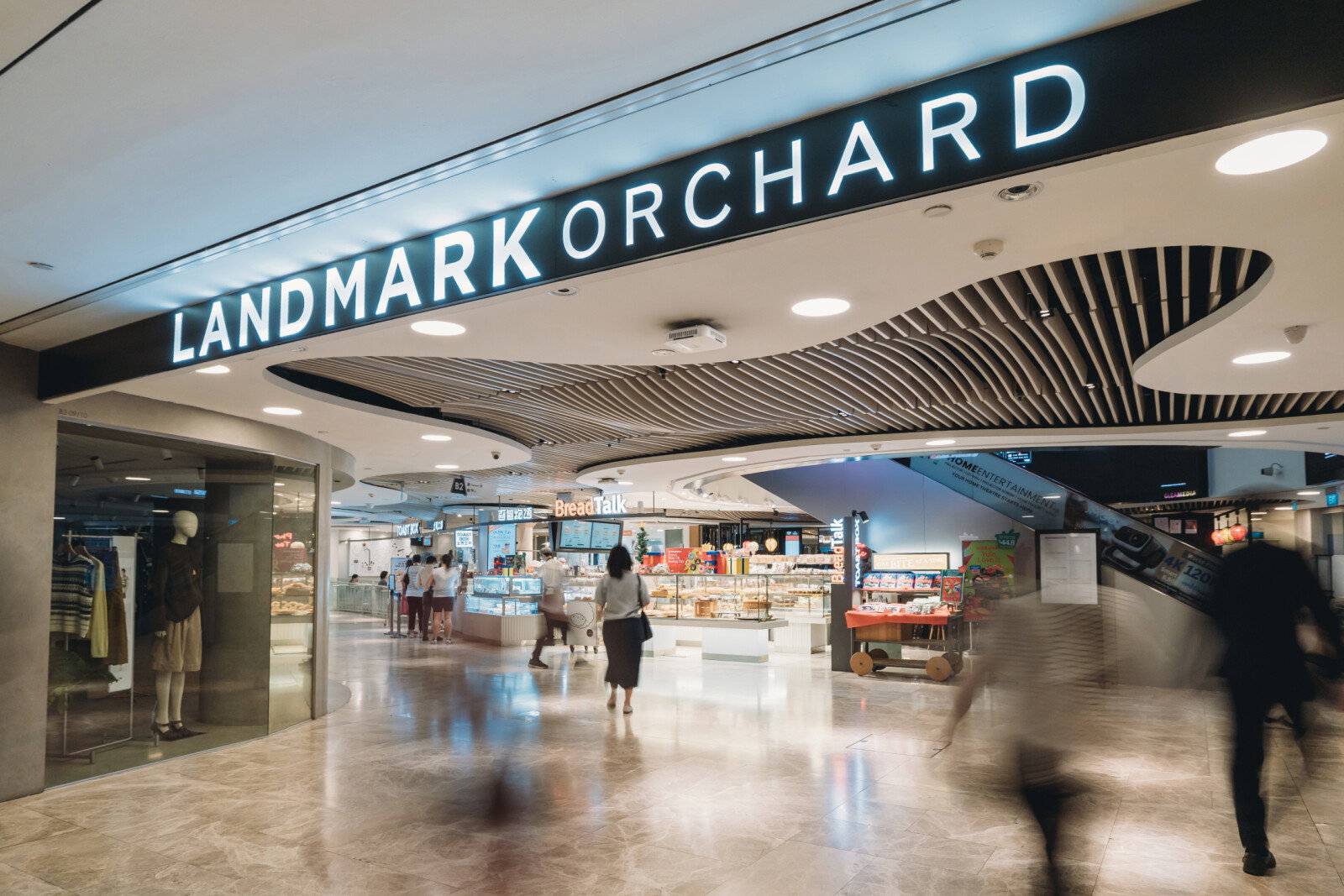
Only the name and the operating mandate: LANDMARK Orchard keeps its existing tenants and visitors, and the building remains a mixed-use commercial property with office and retail space, directly connected to Orchard MRT station. Nothing disclosed to date suggests a change to leases, access or trading hours.
What the new identity replaces is a sign that had stood for more than 30 years along Orchard Road — long enough that "Wheelock Place" functioned as a landmark in its own right for a generation of office tenants and shoppers. Renaming an asset with that kind of recognition is a deliberate trade: the landlord gives up local wayfinding equity in exchange for a name it can reuse across markets.
Why does the fund wrapper matter more than the name?
Because the fund, not the listed group's balance sheet, now owns the asset — and that changes which numbers you should watch. The buyer was the Singapore Central Private Real Estate Fund (SCPREF), which Hongkong Land launched on 3 February 2026 as the city-state's largest private commercial real estate fund, with assets under management of S$8.2 billion at inception. The group's own announcement put AUM at S$9.4 billion once the acquisition completed by end-August 2026, against a stated target of at least S$15 billion.
SCPREF is structured as a perpetual open-end vehicle — meaning it has no fixed termination date and can keep taking in capital, so the manager is judged on recurring income and asset-level execution rather than on a single well-timed exit. Its seed portfolio was already office-heavy: full interests in Asia Square Tower 1 and One Raffles Link, plus interests in Marina Bay Financial Centre Towers 1 & 2, One Raffles Quay and Marina Bay Link Mall. Adding an Orchard Road retail-and-office building is a deliberate diversifier inside a Marina Bay-centric book.
Reported pricing for the acquisition was about S$1.4 billion (US$1.1 billion), a figure carried by The Straits Times and consistent with the AUM step-up disclosed by the group. Treat it as an acquisition-yield question: at that price, the return case rests on lifting net property income, not on a market-wide rent surge.
What does the parent's balance sheet say about timing?
It says the group had room to sequence a fund, a rebrand and a Singapore launch inside roughly eighteen months. For 1H2026, Hongkong Land reported underlying profit of US$259 million, up 11% year on year, with net debt down to US$3.4 billion from US$3.6 billion at end-2025 and US$4.9 billion a year earlier — gearing of roughly 11%. DBS analyst Jeff Yau attributed the improvement primarily to lower net financing costs and noted in a 29 July 2026 result review that negative rental reversions at group level were narrowing as 2026 lease renewals were largely completed.
The brand leg of the sequence predates the deal. Hongkong Land's company-wide rebranding last year, developed by DNCO, replaced a century-old identity with a system built around the line "Experience is central"; trade press reported the identity going live in February 2025. For a group founded in 1889, the point was not cosmetic — it gave the landlord a consumer-facing promise it could carry into retail assets outside Hong Kong, which is exactly what LANDMARK Orchard now tests.
How tight is the Orchard Road market right now?
Not tight enough to bail out a weak operating plan. URA figures reported in July 2026 put retail vacancy in the Orchard Planning Area at 7.2% in Q2 2026, up from 7.1% in Q1, while Cushman & Wakefield recorded prime Orchard rents rising 0.3% quarter on quarter in Q3 2026 — modest, supply-aware growth rather than a re-rating.
That matters for interpretation: in a market drifting sideways, a rebrand has to earn its return from tenant mix, lease structures and dwell time. Singapore's retail mid-market keeps adding space too, as the arrival of Sociolla's first two Singapore stores at Funan and Bugis Junction shows, so Orchard's premium positioning is being defended from two directions at once.
There is also a live adjacency risk to watch. On 14 October 2026, Bloomberg-reported talks between Hongkong Land and Ong Beng Seng's Hotel Properties Ltd over a majority stake in three Orchard Road buildings — voco Orchard, Forum mall and HPL House — with the assets potentially valued above S$2 billion. No transaction has been announced. If it proceeds, the group's Orchard exposure stops being a single-asset experiment and becomes a cluster strategy, which changes both the upside and the concentration question.
What should you monitor? A five-step checklist
The discipline is the same one CompanyWatch applied to SIA's new cabins, backed by more than SG$2 billion: separate headline capital commitments from the operating evidence that has to follow. Apply it here in five steps.
- Fund AUM progression. S$8.2 billion at inception, S$9.4 billion after this deal, at least S$15 billion targeted. Each new closing is a signal about third-party conviction, not just group confidence.
- Rent reversion at the asset. Watch for disclosure of passing rents and reversions at LANDMARK Orchard in later results; reversion is where a rebrand either shows up or does not.
- Occupancy and tenant mix. Anchor tenants staying is table stakes; the readable signal is whether new leases skew to experience-led categories and shorter terms.
- Fee and brand economics. If the LANDMARK name carries a management or brand fee inside the fund, that line will eventually surface in segment disclosure. Until it does, do not assume it.
- Parent leverage. Gearing near 11% is the buffer that lets the group keep seeding assets; a move back toward the 2025 debt level would slow the pace of the roll-out.
| Signal | Where to verify | Supports the thesis if… | Weakens it if… |
|---|---|---|---|
| SCPREF AUM and closings | Hongkong Land and Jardines newsroom releases | Moves toward at least S$15 billion with third-party capital | Growth comes only from sponsor transfers |
| Reversion at LANDMARK Orchard | Half-year and full-year results commentary | Reversions turn positive within two lease cycles | Occupancy is held by discounting rent |
| Orchard vacancy | URA quarterly statistics | Holds near 7% with prime rents grinding up | Vacancy climbs back toward the 2025 highs |
| HPL stake talks | SGX filings and company statements | Cluster built at disciplined pricing | Deal priced above reported S$2 billion expectations |
| Group net debt | Interim results | Stays near US$3.4 billion while seeding continues | Leverage rises to fund the brand roll-out |
Which misreadings should you avoid?
Four traps account for most of the loose commentary on this story.
- Reading a rename as a rent reset. The new identity took effect on 12 November; leases do not reprice because of signage. Reversions arrive on renewal dates, and they arrive at the asset level.
- Confusing sponsor and fund. Hongkong Land manages SCPREF but does not own all of it. Asset performance and group earnings are two different lines, and the gap widens as third-party capital grows.
- Treating LANDMARK as a global promise. The group's own framing is narrow: this is the first time Hongkong Land has brought the LANDMARK name outside Hong Kong. One asset in Singapore is a pilot, not a portfolio announcement — and LANDMARK remains at the heart of the Central portfolio in Hong Kong, where the more than US$1 billion Tomorrow's CENTRAL programme is the flagship test of the same operating model.
- Ignoring the fund's mandate. A perpetual vehicle with a S$15 billion ambition needs a pipeline. Pressure to keep acquiring is a structural feature of the wrapper, and it argues for scrutiny of pricing discipline rather than excitement about announcements.
What is the case read?
The comparison that matters is internal. In Hong Kong, LANDMARK is the group's most concentrated retail and office cluster, and Tomorrow's CENTRAL is the live experiment in whether a landlord can physically re-engineer a district and charge for the experience. LANDMARK Orchard is the export version of that same claim at a single asset, with a fund's return requirements attached.
Fo Pei Teng, chief executive of SCPREF, framed the move in exactly those terms: "This is the first time Hongkong Land has brought the LANDMARK name outside Hong Kong. The name LANDMARK Orchard reflects our commitment to the quality of experience we will create for tenants, visitors and the wider community through this property," said Foo. She added: "Hongkong Land has a long history of investment in its assets and we look forward to bringing that long-term investment approach to LANDMARK Orchard".
The read for a CompanyWatch file: what travels is an operating model — long holds, active management, experience-led positioning — and the brand is the label on the box. If the model travels, the label earns its premium. If it does not, the label is the only thing that moved.
What should decision-makers do next?
Build the tracking file before the evidence arrives, and date-stamp your expectations.
- Set a review date against the next two results cycles and write down what you expect reversion and occupancy to be; unrecorded forecasts cannot be scored.
- Log the HPL question separately from the LANDMARK Orchard thesis. One is a cluster bet, the other an asset-level operating test, and they fail for different reasons.
- Convert brand language into a testable claim: if "Experience is central" is doing commercial work, it should show up in tenant mix, dwell-time proxies and rental levels — not in adjectives.
FAQ: LANDMARK Orchard and Hongkong Land
Is LANDMARK Orchard a new building?
No. It is the former Wheelock Place under a new name, effective 12 November, with the same office and retail space and the same direct connection to Orchard MRT station.
Did Hongkong Land or its fund buy the property?
SCPREF, the Singapore Central Private Real Estate Fund established in February this year, acquired the asset in August 2026, and that purchase was the fund's maiden deal. The listed group sponsors and manages the vehicle.
Will the LANDMARK name now spread across Singapore?
No plan for that has been disclosed. The group describes this as the first time it has taken LANDMARK outside Hong Kong, and any second asset would have to come through fund acquisitions or renames that have not been announced.
Does the rebrand affect existing tenants?
Not according to disclosed information: the property will continue to serve its existing tenants and visitors under the new name, and no lease changes were announced alongside the identity.
What is Tomorrow's CENTRAL?
It is the group's more than US$1 billion transformation programme for its LANDMARK-anchored Central portfolio in Hong Kong — the reference case against which LANDMARK Orchard's operating ambition should be measured.
Sources and verification
- Hongkong Land, SCPREF launch release, 3 February 2026: webfile.hkland.com
- Jardines newsroom, SCPREF acquisition of Wheelock Place: jardines.com
- Reuters, Hongkong Land launches S$8.2 billion Singapore private real estate fund, 3 February 2026: reuters.com
- The Edge Singapore, 1H2026 results, 28 July 2026: theedgesingapore.com
- DBS Group Research, Hongkong Land result analysis, 29 July 2026: dbs.com.sg
- Business Times, Singapore retail rents and Orchard vacancy, 24 July 2026: businesstimes.com.sg
- Cushman & Wakefield, Singapore retail MarketBeat: cushmanwakefield.com
- Business Times, Hongkong Land in talks with HPL, 14 October 2026: businesstimes.com.sg
- DNCO, Hongkong Land corporate brand case study: dnco.com
- Channel NewsAsia, Wheelock Place renamed Landmark Orchard, 12 November 2026: channelnewsasia.com