
CompanyWatch: Tesla Cybercab’s CIIE Asia Debut — What Robotaxi Data and Model Y Parts Reveal
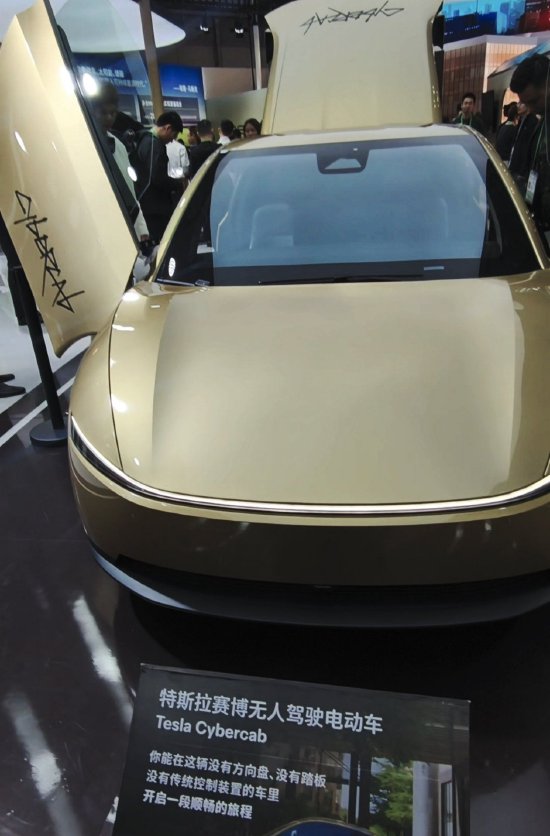
CompanyWatch read: Tesla used the Cybercab’s Asia debut at the China International Import Expo to show a driverless design story tied to Robotaxi operations in the United States: Austin service began this September 3, the fleet grew to more than 300 vehicles within 30 days, and as of October 18 it had logged about 5 million kilometres with zero airbag deployments.
The display was not only a product reveal. State Council Information Office coverage, quoting Xinhua, said Tesla’s Cybercab made its Asia-Pacific debut in the Automobile and Smart Mobility area. That places the moment where CompanyWatch readers should look: at a single company’s attempt to convert an exhibition appearance into evidence about design, manufacturing readiness, overseas positioning and the pace of autonomous mobility.
Why Did Tesla Bring Cybercab to the China International Import Expo?
Conclusion first: CIIE gave Tesla an Asian public venue for a vehicle whose commercial proof still comes from the United States. The Cybercab is positioned as a steering-wheel-free robotaxi, and its appearance in Shanghai gave investors, industry observers and consumers a physical reference point for a product that is normally discussed through software claims.
The strategic reason is simple. A trade-fair debut can do three things at once: it normalises the concept, it puts the vehicle inside an industrial rather than speculative setting, and it creates a bridge to potential regional partners. Still, the same exhibit did not claim local Robotaxi service; the operating evidence remained Austin, where Cybercab entered public Robotaxi use this September 3.
How Strong Are the Robotaxi Operating Numbers?
The strongest part of the story is speed, not scale. Tesla said the fleet reached more than 300 vehicles within 30 days, a rise to ten times the previous level. The company also said the Robotaxi fleet accumulated about 5 million kilometres with no safety driver in the car, zero airbag deployments and no active-collision injuries.
That is meaningful because it ties the physical debut to operational outcomes. A robotaxi exhibit without fleet data is theatre; fleet data without public definitions is incomplete. Tesla’s later safety reporting, summarised by Drive Tesla Canada, placed the fleet metric around 3.1 million driverless miles as of October 18, which corresponds closely to the about 5 million kilometres figure.
Read this as an early-stage industrial milestone. It shows Tesla can build and deploy vehicles under a driverless configuration, but it does not yet answer how the service behaves under weather, construction zones, mixed traffic, passenger abuse, remote-intervention latency or accident-liability allocation.
Data Citations: What the CIIE Display Supports
| Signal | Reported anchor | Useful reading | Caution |
|---|---|---|---|
| Asia debut | CIIE in Shanghai | Public regional exposure | Not a service approval |
| Start date | this September 3 | Operational traction | Needs longer observation |
| Fleet ramp | more than 300 vehicles within 30 days | Production and deployment velocity | Pilot base can grow quickly |
| Distance | about 5 million kilometres as of October 18 | Proof of accumulated autonomy | Denominator and conditions matter |
| Safety language | zero airbag deployments | Early harm-reduction signal | Not full incident transparency |
| Hardware view | Model Y exploded parts | Manufacturing and repair logic | Does not directly reveal Cybercab cost |
Why Does the Model Y Exploded View Matter?
Conclusion: it shifts the exhibit from autonomy branding to industrial storytelling. Tesla’s first display of a Model Y exploded view let visitors examine body structure, battery system and key components. For a robotaxi company, the question is not only whether a car can drive itself, but whether it can be produced, maintained and replaced at low enough cost to make fleet economics work.
Model Y is central because it is presented as Tesla’s global sales champion, and its parts view offers a practical lens. If the robotaxi platform can inherit disciplined cost engineering, Cybercab’s expansion becomes more than a software demo. The exhibit therefore complements the Robotaxi numbers: one shows the service is moving, the other shows the hardware story is visible.
Common Misconceptions About the Cybercab Debut
- Misconception: an Asia debut means Cybercab is immediately available for local ride-hailing. Reality: the operating proof discussed at the event remained tied to the United States and Austin.
- Misconception: zero airbag deployments is equivalent to total safety. Reality: it is a selected, favourable metric; incident classification, remote monitoring and non-deployment events still matter.
- Misconception: ten times fleet growth proves commercial viability. Reality: a ten-times rise from a small base can be fast, but unit economics depend on rides, utilisation, maintenance and charging downtime.
- Misconception: the Model Y exploded view proves Cybercab is cheap. Reality: it supports a manufacturing narrative, but it does not disclose Cybercab’s bill of materials.
What Should Analysts Track Next?
- Reported driverless miles per vehicle per day, not total fleet count.
- Share of rides completed without remote assistance, with clearer definitions.
- Incident granularity: police reports, property-damage-only crashes, injuries, disengagements and road-condition exceptions.
- Regulatory status in each new geography, including permit boundaries and insurance language.
- Cost and repair signals from battery, body and software updates tied to Cybercab.
Action Recommendations for CompanyWatch Readers
- Treat the CIIE appearance as a demand-generation and positioning signal, not a confirmed Asia revenue event.
- Compare fleet growth with mileage productivity: more vehicles do not automatically mean more paid rides.
- Check the source of safety claims: zero airbag deployments needs a full incident appendix before it can support long-term conclusions.
- Follow manufacturing indicators, not only showroom moments. A related GlobalBizSight read on Tesla’s Austin night shift explains how staffing cadence can reveal whether Cybercab output is becoming routine.
FAQ: Reading Cybercab’s CIIE Appearance
Did Tesla announce Cybercab service in China?
No. The CIIE event was an Asia debut of a Cybercab exhibit, while the public operating evidence cited was from the United States and Austin.
What makes the Robotaxi figures noteworthy?
The combination is unusual: service began this September 3, the fleet reached more than 300 vehicles within 30 days, the scale was ten times the earlier level, and as of October 18 the fleet had about 5 million kilometres and zero airbag deployments.
Why is zero airbag deployments not enough?
It is a strong early indicator of avoiding injury-level events, but it does not capture every collision, remote-intervention need or non-airbag incident category.
What is the Model Y exploded view showing?
It presents body, battery-system and key-part design, helping visitors judge Tesla’s manufacturing and reliability story beyond autonomy claims.
Reference Sources
- State Council Information Office, citing Xinhua, “Tesla demonstrates firm commitment to global cooperation at import expo”: http://english.scio.gov.cn/m/in-depth/2025-11/06/content_118163069.html
- Xinhua English, “Tesla’s Cybercab makes Asia-Pacific debut at 8th CIIE”: https://english.news.cn/20251107/bc978e3b2eba4e3485e5a3c48610c5e8/c.html
- Drive Tesla Canada, “Tesla Launches Robotaxi Safety Report, Claims Zero Injuries”: https://driveteslacanada.ca/robotaxi/tesla-robotaxi-safety-report-zero-injuries/
- Tesla, Robotaxi Safety Report: https://www.tesla.com/robotaxi/safety